



Personal estate planning counsel in Northern California
A lake shoreline at dusk with mountains behind

Practice area · Estate Tax Planning

Estate Tax Planning

For estates near or above the federal exemption, planning decides whether 40% of the excess goes to tax — or stays with your family.

Counsel
Elaine Andrews, Certified Specialist
Service area
Northern California · Office in Truckee
First meeting
Free initial consultation

In plain terms

Estate tax planning uses federal exemptions, deductions and trusts to reduce or eliminate the federal estate tax, a tax of up to 40% on the value of an estate above the exemption — $15 million per person in 2026, indexed for inflation in later years. California has no estate tax of its own. The main tools are portability between spouses, the unlimited marital and charitable deductions, lifetime gifts, generation-skipping planning and irrevocable trusts that hold life insurance or appreciating assets.

Who needs estate tax planning now

Federal tax legislation enacted in 2025 set the basic exclusion at $15 million per person starting in 2026, so a married couple can shelter up to $30 million with portability or planning. Families with estates near those figures — often because of a business, real estate holdings or life insurance — benefit from planning, as do families with property in states that impose their own estate tax, such as Washington and Oregon. The Andrews Law Firm, P.C. coordinates estate tax planning with clients’ CPAs and financial advisors.

  1. 01 The tax and the exemption How the federal estate tax works · Portability for married couples · The marital deduction and non-citizen spouses
  2. 02 Planning tools Lifetime gifts · Irrevocable life insurance trusts · Advanced trusts for larger estates
  3. 03 Beyond one generation Generation-skipping transfer tax · Property in other states · Keeping the plan current
Three generations of a family walking on a trail at dusk

Chapter 01

The tax and the exemption

How the federal estate tax is calculated, portability for married couples and the marital deduction.

How the federal estate tax works

The calculation follows a fixed sequence:

  • Gross estate — everything owned or controlled at death, including life insurance the decedent owned, retirement accounts and the decedent’s share of community property.
  • Deductions — debts, expenses, property passing to a U.S. citizen spouse (the unlimited marital deduction) and to charity.
  • Taxable estate — plus adjusted taxable gifts made during life.
  • Exemption — the basic exclusion amount, $15 million per person in 2026, plus any unused exemption received from a deceased spouse.
  • Tax — up to 40% on the amount above the exemption, with the return (Form 706) due nine months after death.

Portability for married couples

When the first spouse dies, the unused part of that spouse’s exemption — the deceased spousal unused exclusion amount — can pass to the survivor, but only if the executor files a timely estate tax return electing portability, even when no tax is due. The IRS allows a simplified late election within five years after death for estates that were not otherwise required to file (Revenue Procedure 2022-32). Portability does not carry over the generation-skipping transfer tax exemption, and the amount carried over is not indexed for inflation.

The marital deduction and non-citizen spouses

Property passing to a surviving spouse who is a U.S. citizen qualifies for an unlimited marital deduction, deferring tax until the survivor’s death. If the surviving spouse is not a U.S. citizen, the marital deduction is generally available only through a qualified domestic trust, or QDOT (Internal Revenue Code §2056A). Trusts that qualify for the deduction, such as QTIP trusts, let the first spouse to die decide who ultimately receives the property.

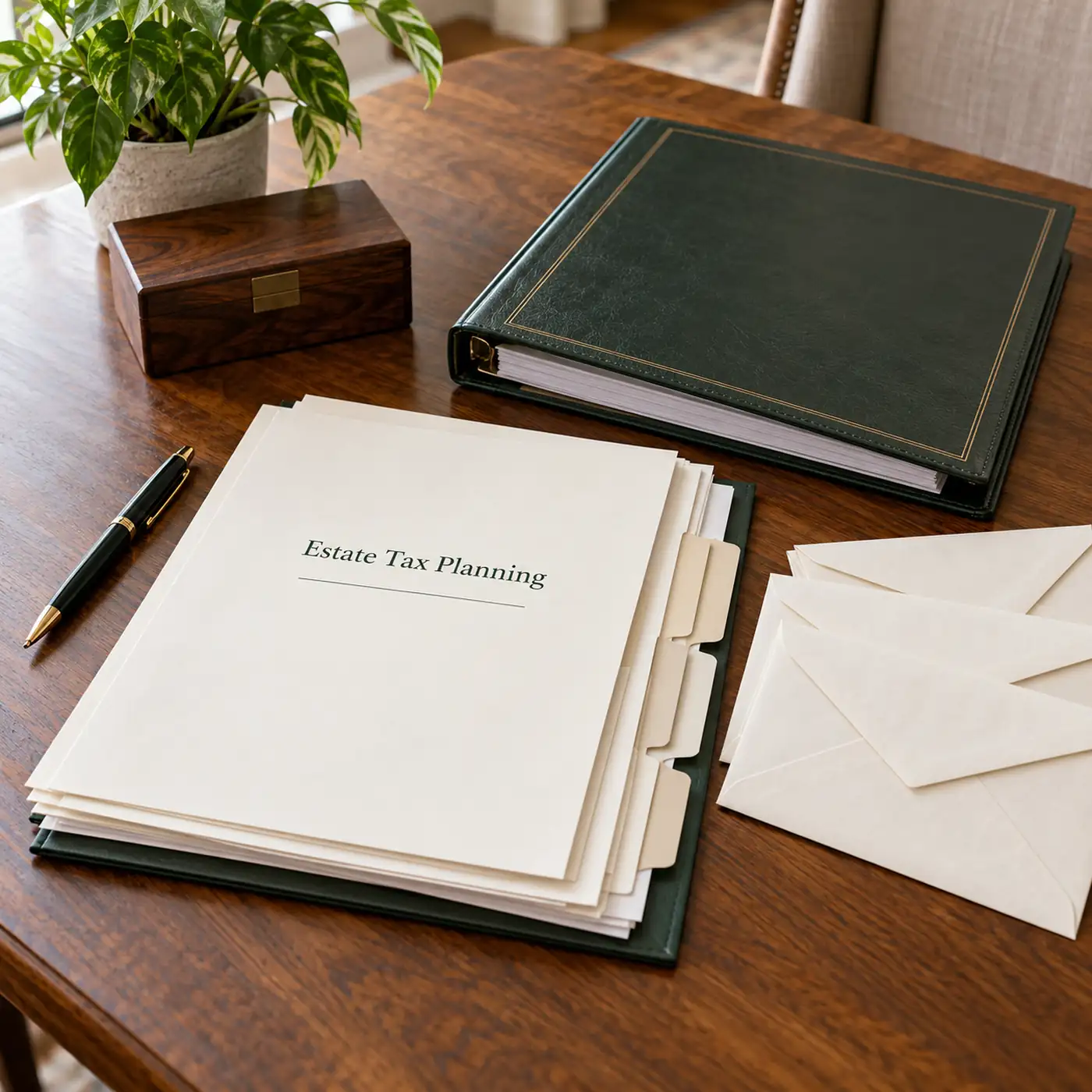
Legal documents and a fountain pen on a walnut desk

Chapter 02

Planning tools

Lifetime gifts, irrevocable life insurance trusts and advanced trusts for larger estates.

Lifetime gifts

Gifts up to the annual exclusion — $19,000 per recipient in 2026 — do not use any exemption. Larger gifts use the lifetime exemption, which is unified with the estate tax exemption. Giving removes future appreciation from the estate, but gifted property keeps the donor’s income tax basis, so the estate tax saved must be weighed against the capital gains heirs may later pay.

Irrevocable life insurance trusts

Life insurance owned by the insured is included in the gross estate. An irrevocable life insurance trust (ILIT) that owns the policy keeps the proceeds out of the estate and can provide cash to pay estate tax or to equalize inheritances. A policy transferred to the trust within three years before death is pulled back into the estate (Internal Revenue Code §2035), so new policies are usually purchased by the trust directly.

Advanced trusts for larger estates

Spousal lifetime access trusts (SLATs), grantor retained annuity trusts (GRATs), sales to intentionally defective grantor trusts and family limited partnerships can use the exemption efficiently or shift future growth to heirs. Each carries tax, control and family considerations, and California’s community property rules require care when one spouse makes gifts of community property.

A lake shoreline at sunset with mountains behind

Chapter 03

Beyond one generation

The generation-skipping transfer tax, property in states with their own estate tax and keeping the plan current.

Generation-skipping transfer tax

Gifts and bequests to grandchildren, or to trusts that last for several generations, can be subject to a separate generation-skipping transfer tax at a flat 40%. Each person has a GST exemption equal to the basic exclusion amount. Allocating the exemption to a long-term trust can keep the property outside the estate tax system for generations.

Property in other states

California has no estate tax, and neither does Nevada. Washington and Oregon impose their own estate taxes with much lower exemptions, and a Californian who owns real estate there can owe state estate tax on it. Holding out-of-state property through the right entity or trust can reduce that exposure.

Keeping the plan current

Exemptions and rates have changed many times. A plan written when the exemption was much lower may divide property into trusts that no longer save tax and may give up the step-up in basis at the second death. Review an estate tax plan whenever the law, your net worth or your family changes.

A multi-generation family gathered on a porch in the mountains

Who this is for

Estate tax planning matters if any of these is true.

Talk it through
  • Your estate, including life insurance, approaches $15 million per person.
  • You own a closely held business or significant real estate.
  • Your spouse is not a U.S. citizen.
  • Your trust divides into separate trusts at the first death.
  • You own property in Washington, Oregon or another state with an estate tax.
  • You want to leave assets to grandchildren or future generations.
  • Your spouse died recently and no estate tax return was filed.

How it works

From projection to a plan that holds.

Direct guidance from a Certified Specialist at every step.

  1. 01

    First meeting

    Estimate the gross estate, including insurance and retirement accounts.

  2. 02

    Projection

    Model the estate tax under current law with your CPA.

  3. 03

    Strategy

    Choose among portability, trusts, gifts and charitable tools.

  4. 04

    Documents

    Prepare trusts, gift documents and insurance ownership changes.

  5. 05

    Returns

    File gift tax returns and portability elections on time.

  6. 06

    Review

    Update as exemptions, values and your family change.

California at a glance

Estate Tax Planning, by the numbers that matter.

Federal exemption
$15 million per person (2026)Indexed for inflation each year. A married couple can shelter up to $30 million with planning.
Portability
Requires a timely Form 706A surviving spouse can use a deceased spouse’s unused exemption only if an estate tax return elects portability.
Top federal rate
40%Applies to taxable transfers above the available exemption.
California
No state estate taxCalifornia does not impose an estate or inheritance tax; property tax under Proposition 19 still deserves review.

General California and federal information current as of 2026. Figures adjust over time and every situation is different; confirm how a rule applies to you before acting.

Mistakes we see most often.

Skipping the portability election
Without a timely Form 706, the deceased spouse’s unused exemption is lost.
Owning life insurance personally
The proceeds count in the taxable estate.
Giving low-basis assets without analysis
The estate tax saved can be offset by capital gains for heirs.
Keeping an outdated A/B split
Old formulas can lock assets in trusts that no longer save tax.
Forgetting state estate taxes
Washington or Oregon property can trigger a separate state tax.
Overlooking a non-citizen spouse
Without a QDOT, the marital deduction may be lost.

This page covers

  • Federal estate tax exemption
  • 40% estate tax rate
  • Portability
  • Form 706
  • Marital deduction
  • QDOT trusts
  • Annual gift exclusion
  • Irrevocable life insurance trusts
  • SLATs and GRATs
  • Generation-skipping transfer tax
  • State estate taxes
  • Charitable deduction

In clients’ own words.

All client reviews
Posted on Google Google
Ronald Schmader profile picture
Ronald Schmader
Google star 1Google star 2Google star 3Google star 4Google star 5Trustindex verifies that the original source of the review is Google.
As grieving parents of our deceased son, we were in need of guidance with regard to what do we do next. Our son was without a will and, we had no experience with how to proceed. Luckily, we contacted Elane at the Andrews Law Firm Truckee who immediately understood our situation and was able to provide the information we needed and the necessary legal paperwork to resolve our problem. Our problem was magnified by the fact that we live in Milwaukee and involved my son's car for which we could not find the title. Rather than have to return to Truckee after 40 days to request a new title, Elane assisted us in creating a power attorney for a friend in Truckee which negated our having to return to Truckee from Milwaukee to simply apply for a new title. We are very appreciative with the help we found at The Andres Law Firm Truckee. Thank you, Elaine!
Posted on Google Google
David VanderJagt profile picture
David VanderJagt
Google star 1Google star 2Google star 3Google star 4Google star 5Trustindex verifies that the original source of the review is Google.
We really appreciate all the excellent work the Andrew’s Law Firm has done with updating our Trust. Her attention to detail is very appreciated and guiding us through our Trust planning has been exemplary . David and Linda VanderJagt
Posted on Google Google
I “Sue” S profile picture
I “Sue” S
Google star 1Google star 2Google star 3Google star 4Google star 5Trustindex verifies that the original source of the review is Google.
Quick and efficient handling of my new Trust.
Posted on Google Google
Stephanie (Lady Lebala) profile picture
Stephanie (Lady Lebala)
Google star 1Google star 2Google star 3Google star 4Google star 5Trustindex verifies that the original source of the review is Google.
We were referred to Elaine Andrew's law firm through a friend and I'm very happy we went and sat down with her. She quickly recognized a few mistakes in our previous trust and worked to correct them and ensure that our trust followed all legal requirements. We now feel confident that we have a very solid trust for the future.
Posted on Google Google
Cindy Ann Homer profile picture
Cindy Ann Homer
Google star 1Google star 2Google star 3Google star 4Google star 5Trustindex verifies that the original source of the review is Google.
Elaine was very supportive and professional. She sincerely listened to my concerns and questions. She advised me of California Laws and guided me through the process of what steps would be the best for preparing my will. Kenneth reviewed page by page of my will with me (before signing) and answered all of my questions. I highly recommend The Andrews Law Firm they made my dreaded will preparation bearable. Thank you.
Posted on Google Google
Linda Smith profile picture
Linda Smith
Google star 1Google star 2Google star 3Google star 4Google star 5Trustindex verifies that the original source of the review is Google.
Process was quick and easy. Appreciated all the help they provided.

This testimonial or endorsement does not constitute a guarantee, warranty, or prediction regarding the outcome of your legal matter.

Frequently asked questions

Questions clients ask about estate tax planning.

Straight answers to start with. Bring your own documents and circumstances to a free consultation for advice that fits.

All frequently asked questions
What is the federal estate tax exemption in 2026?

$15 million per person, indexed for inflation in later years. A married couple can shelter up to $30 million with portability or planning.

Does California have an estate tax?

No. California has no estate, inheritance or gift tax. Only the federal estate tax applies to most California estates.

What is portability?

The transfer of a deceased spouse’s unused exemption to the surviving spouse. It requires a timely estate tax return electing portability, even when no tax is due.

Do I need to file an estate tax return if no tax is due?

Only if the gross estate exceeds the filing threshold — or to elect portability for a surviving spouse, which is often worth doing.

What is the estate tax rate?

Up to 40% on the amount above the exemption.

Is life insurance subject to estate tax?

Yes, if you own the policy or hold incidents of ownership at death. An irrevocable life insurance trust can keep the proceeds out of your estate.

What is an ILIT?

An irrevocable life insurance trust that owns a life insurance policy so the proceeds are not included in the insured’s estate. Policies transferred within three years before death are pulled back in (Internal Revenue Code §2035).

Can gifts reduce estate tax?

Yes. Annual exclusion gifts of $19,000 per recipient in 2026 use no exemption, and larger gifts remove future appreciation from the estate — at the cost of the step-up in basis.

What is the generation-skipping transfer tax?

A separate 40% tax on transfers to grandchildren or more remote generations, with its own exemption equal to the basic exclusion amount.

What if my spouse is not a U.S. citizen?

The unlimited marital deduction is generally available only for property left in a qualified domestic trust (QDOT) (Internal Revenue Code §2056A).

Do I owe estate tax on property in another state?

Possibly. Washington and Oregon impose their own estate taxes with lower exemptions on real estate located there. Nevada has none.

Will the exemption change again?

Congress can change it at any time. Current law sets $15 million per person from 2026, indexed for inflation, and a good plan stays flexible.

Northern California service areas

Local guidance, without the long list.

Explore the regions where The Andrews Law Firm provides California-focused counsel. Find your community from one organized coverage page, or contact our Truckee office for consultation options.

View areas served

Related practice areas

Start with one clear conversation.

Bring your questions, your documents and the decisions you want help with. The first consultation is free.