



Personal estate planning counsel in Northern California
A house key and trust documents on a desk in a mountain home

Practice area · Living Trusts

Living Trusts in California

A revocable living trust lets you control your property today, names who takes over if you can’t, and passes funded assets to your family without probate.

Counsel
Elaine Andrews, Certified Specialist
Service area
Northern California · Office in Truckee
First meeting
Free initial consultation

In plain terms

A revocable living trust is a written agreement in which you transfer your property to yourself as trustee, keep full control while you are alive and able, and name a successor trustee to manage and distribute it at your incapacity or death. In California a trust is revocable unless it expressly says otherwise (Probate Code §15400), and it controls only the assets actually titled in its name — which is why funding matters as much as drafting.

What a living trust does — and doesn’t do

A funded trust keeps your home and accounts out of probate, keeps your distribution plan out of the public court file and lets a successor trustee act immediately if you become incapacitated, without a conservatorship of the estate. It does not reduce income taxes, does not shield assets from your own creditors and does not replace a will, a power of attorney or a health care directive. The Andrews Law Firm, P.C. — led by Elaine Andrews, a State Bar of California Certified Specialist in Estate Planning, Trust and Probate Law — prepares, funds and reviews living trusts for individuals and couples across Truckee, Lake Tahoe and the Northern Sierra.

  1. 01 How it works How a revocable living trust works · Funding: titling your property in the trust · Living trust or will: what changes at death
  2. 02 Who it protects Incapacity: who manages your affairs · Joint trusts for married couples · Protecting children and other beneficiaries
  3. 03 Property and limits Real estate, family cabins and Proposition 19 · What a living trust does not do · Amending, restating and reviewing a trust
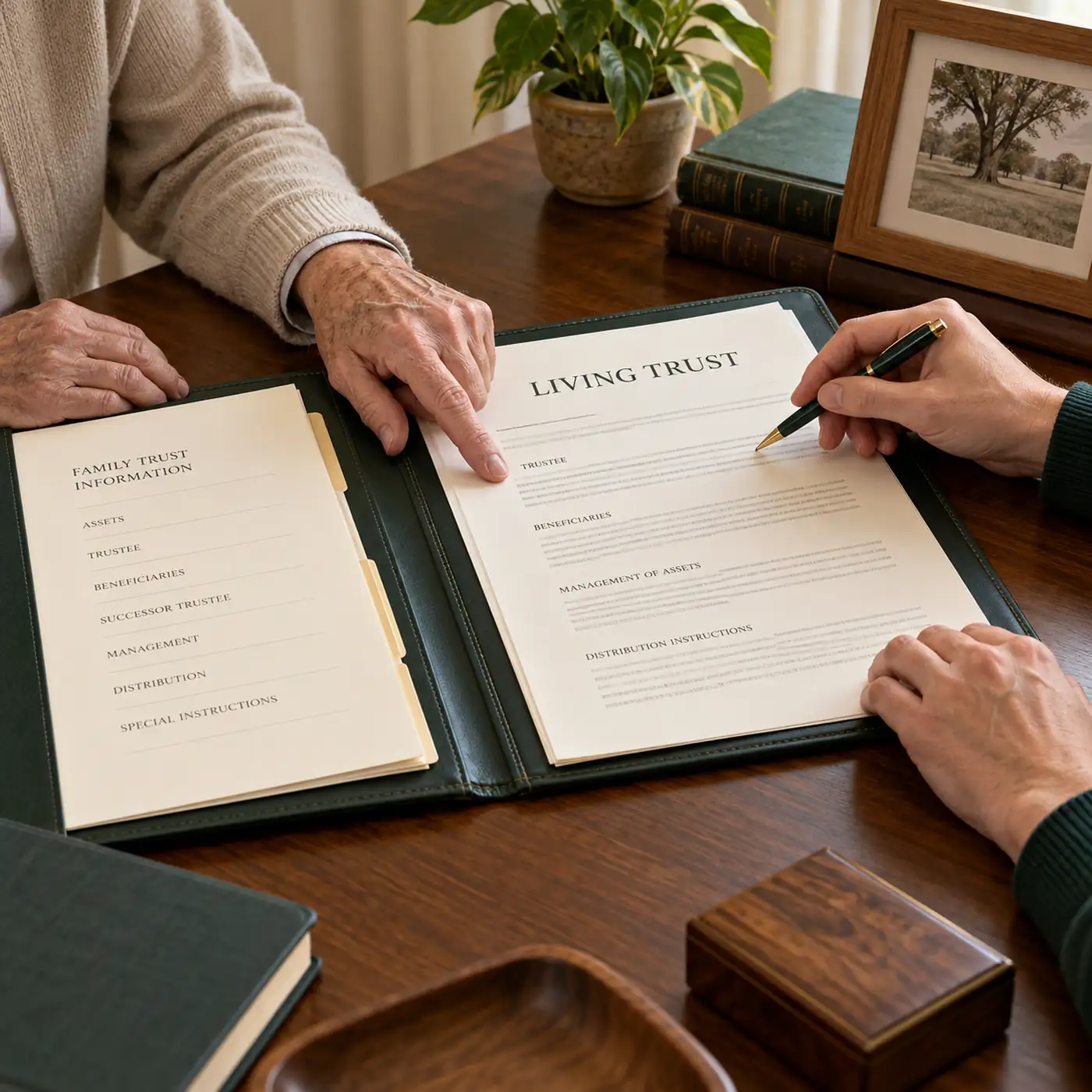
A house key and a folder of trust documents on a wooden table

Chapter 01

How it works

The roles in a living trust, the funding step that makes it work, and what changes for your family at death.

How a revocable living trust works

Every living trust has the same roles, and at the start you usually hold most of them yourself:

  • Settlor (or trustor) — the person who creates the trust and transfers property into it.
  • Trustee — the person who manages trust property. You serve as your own trustee during your lifetime; married couples usually serve together.
  • Beneficiary — the person the trust benefits. You are the beneficiary during your life; your children, other family or charities follow.
  • Successor trustee — the person or professional fiduciary you name to take over at your incapacity or death.
  • Pour-over will — a companion will that moves any asset left outside the trust into it and nominates guardians for minor children.

Funding: titling your property in the trust

Signing the trust is only half the work. Real estate is transferred by a deed to you as trustee, recorded with the county; bank and brokerage accounts are retitled or given a payable-on-death designation to the trust; business interests are assigned under the company’s operating agreement or bylaws. Retirement accounts stay in your name and are coordinated through beneficiary designations. Transferring your home into your own revocable trust is not a change in ownership for property tax purposes, so it does not trigger reassessment (Revenue and Taxation Code §62(d)). If an asset is missed, a Heggstad petition (Probate Code §850) may confirm it belongs to the trust — but correct funding avoids that court step.

Living trust or will: what changes at death

With a will alone, assets in your own name above $208,850 generally go through probate — a public court process whose statutory fees are calculated on the gross value of the estate (Probate Code §10810). With a funded trust, the successor trustee gathers the assets, pays final bills and taxes and distributes under the trust’s terms without a probate filing. The trustee still has duties: notifying beneficiaries and heirs within 60 days (Probate Code §16061.7), keeping beneficiaries reasonably informed and accounting for every transaction.

A grandparent and a grandchild by a window in a mountain home

Chapter 02

Who it protects

Incapacity planning, joint trusts for married couples and the protections a trust can build in for children and other beneficiaries.

Incapacity: who manages your affairs

If you can no longer manage your finances, your successor trustee takes over the trust property under the incapacity standard written in the trust — often a written determination by one or two physicians. Without a trust or a durable power of attorney, a family may have to petition the court for a conservatorship of the estate (Probate Code §1801). The trust and the power of attorney work together: the trustee manages trust assets, and the agent handles everything outside the trust, such as retirement accounts and tax returns.

Joint trusts for married couples

Most married couples in California sign one joint trust that holds their community property and each spouse’s separate property, with schedules that identify which is which. At the first death the trust can remain fully revocable for the survivor or divide into separate shares, depending on the family, the size of the estate and whether there are children from earlier relationships. Holding community property in the trust preserves its character, and at the first death both halves of community property generally receive a new income tax basis (Internal Revenue Code §1014(b)(6)).

Protecting children and other beneficiaries

A trust can hold a child’s share until a stated age, release it in stages or keep it in trust for life, with a trustee who can pay for education, health and support. Spendthrift provisions protect a beneficiary’s share from the beneficiary’s creditors (Probate Code §15300). For a beneficiary who receives public benefits, a special needs trust can supplement those benefits instead of replacing them. These provisions are a main reason a trust can do more than a will.

A wooden cabin among tall pines near Lake Tahoe

Chapter 03

Property and limits

Family homes and cabins under Proposition 19, what a revocable trust cannot do, and how to keep it current.

Real estate, family cabins and Proposition 19

A trust is the usual way to hold a Truckee or Tahoe home, a vacation cabin or rental property so it passes without probate — including property in Nevada, which would otherwise need a separate probate there. Since February 16, 2021, Proposition 19 limits the parent-child property tax exclusion to a family home or family farm that becomes the child’s principal residence, and only up to the parent’s taxable value plus $1,044,586 for transfers between February 16, 2025 and February 15, 2027. A trust can also set terms for a shared family property: who may use it, who pays the costs and how one heir can buy out the others.

What a living trust does not do

A revocable trust does not protect assets from your creditors during your lifetime (Probate Code §18200), does not reduce income tax — while you are alive the trust reports under your own Social Security number — and does not by itself reduce federal estate tax, which applies only above the exemption of $15 million per person in 2026. It also does not control retirement accounts or life insurance, which pass by beneficiary designation.

Amending, restating and reviewing a trust

While you have capacity you can amend the trust, or replace its terms with a restatement that keeps the original trust name and date so assets already titled in it stay put. Review the trust after a marriage, divorce, birth or death, a move to or from California, a significant purchase or sale, or a change in tax law. A certification of trust (Probate Code §18100.5) lets banks and title companies confirm the trustee’s authority without reading the whole document.

A couple talking over documents at a kitchen table

Who this is for

A living trust is worth considering if any of these is true.

Talk it through
  • You own a home or land in California.
  • You own property in Nevada or another state.
  • Your accounts outside retirement plans add up to more than the small-estate limit.
  • You want someone you choose to manage your finances if you become incapacitated.
  • You have minor children or a beneficiary who should not inherit outright.
  • You are married and want the survivor to keep control without a court process.
  • You want your distribution plan to stay private.

How it works

From first meeting to a funded trust.

Direct guidance from a Certified Specialist at every step.

  1. 01

    Free initial consultation

    Review what you own, how it is titled and who you want as trustees and beneficiaries.

  2. 02

    Design

    Decide trustees, distribution terms, ages and protections for children, and what happens at the first death for a couple.

  3. 03

    Drafting

    Review the trust, pour-over will, powers of attorney and health care directive in draft before signing.

  4. 04

    Signing

    Sign the trust before a notary; the will is signed before two witnesses.

  5. 05

    Funding

    Record deeds for real estate, retitle accounts and coordinate beneficiary designations with the trust.

  6. 06

    Review

    Revisit the trust after changes in your family, your property or the tax law.

California at a glance

Living Trusts, by the numbers that matter.

Probate avoidance
Only for funded assetsProperty titled to the trust passes without probate. Property left in your own name can still require a court process.
Funding fix
Heggstad petitionWhen an asset was meant for the trust but never retitled, a petition under Probate Code §850 can ask the court to confirm it belongs to the trust.
Revocability
Revocable by defaultA California trust is revocable by the settlor unless the instrument expressly makes it irrevocable (Probate Code §15400).
Family home and Prop 19
$1,044,586 exclusionA parent-to-child transfer of a family home keeps the parent’s taxable value only if the child makes it a principal residence; market value above that base plus $1,044,586 is added (transfers from February 16, 2025 to February 15, 2027).

General California and federal information current as of 2026. Figures adjust over time and every situation is different; confirm how a rule applies to you before acting.

Mistakes we see most often.

Leaving the house out of the trust
A deed that was never recorded, or a refinance that moved the home out of the trust, can send it to probate or require a Heggstad petition.
Retitling a retirement account to the trust
An IRA or 401(k) stays in your name; changing the owner can be treated as a full withdrawal and taxed.
Choosing a successor trustee by birth order
The best trustee is organized, available and trusted by the other beneficiaries — sometimes a professional fiduciary.
Assuming the trust protects against creditors
A revocable trust offers no protection from your own creditors (Probate Code §18200).
Forgetting out-of-state property
A Nevada condo or an Arizona lot left outside the trust can require a probate in that state.
Never updating an older trust
Trusts written before portability may force a split into separate trusts at the first death that no longer serves the family.

This page covers

  • Revocable living trusts
  • Trust funding
  • Pour-over wills
  • Successor trustees
  • Joint trusts for married couples
  • Community property
  • Heggstad petitions
  • Proposition 19
  • Out-of-state property
  • Spendthrift provisions
  • Special needs trusts
  • Certification of trust

In clients’ own words.

All client reviews
Posted on Google Google
Ronald Schmader profile picture
Ronald Schmader
Google star 1Google star 2Google star 3Google star 4Google star 5Trustindex verifies that the original source of the review is Google.
As grieving parents of our deceased son, we were in need of guidance with regard to what do we do next. Our son was without a will and, we had no experience with how to proceed. Luckily, we contacted Elane at the Andrews Law Firm Truckee who immediately understood our situation and was able to provide the information we needed and the necessary legal paperwork to resolve our problem. Our problem was magnified by the fact that we live in Milwaukee and involved my son's car for which we could not find the title. Rather than have to return to Truckee after 40 days to request a new title, Elane assisted us in creating a power attorney for a friend in Truckee which negated our having to return to Truckee from Milwaukee to simply apply for a new title. We are very appreciative with the help we found at The Andres Law Firm Truckee. Thank you, Elaine!
Posted on Google Google
David VanderJagt profile picture
David VanderJagt
Google star 1Google star 2Google star 3Google star 4Google star 5Trustindex verifies that the original source of the review is Google.
We really appreciate all the excellent work the Andrew’s Law Firm has done with updating our Trust. Her attention to detail is very appreciated and guiding us through our Trust planning has been exemplary . David and Linda VanderJagt
Posted on Google Google
I “Sue” S profile picture
I “Sue” S
Google star 1Google star 2Google star 3Google star 4Google star 5Trustindex verifies that the original source of the review is Google.
Quick and efficient handling of my new Trust.
Posted on Google Google
Stephanie (Lady Lebala) profile picture
Stephanie (Lady Lebala)
Google star 1Google star 2Google star 3Google star 4Google star 5Trustindex verifies that the original source of the review is Google.
We were referred to Elaine Andrew's law firm through a friend and I'm very happy we went and sat down with her. She quickly recognized a few mistakes in our previous trust and worked to correct them and ensure that our trust followed all legal requirements. We now feel confident that we have a very solid trust for the future.
Posted on Google Google
Cindy Ann Homer profile picture
Cindy Ann Homer
Google star 1Google star 2Google star 3Google star 4Google star 5Trustindex verifies that the original source of the review is Google.
Elaine was very supportive and professional. She sincerely listened to my concerns and questions. She advised me of California Laws and guided me through the process of what steps would be the best for preparing my will. Kenneth reviewed page by page of my will with me (before signing) and answered all of my questions. I highly recommend The Andrews Law Firm they made my dreaded will preparation bearable. Thank you.
Posted on Google Google
Linda Smith profile picture
Linda Smith
Google star 1Google star 2Google star 3Google star 4Google star 5Trustindex verifies that the original source of the review is Google.
Process was quick and easy. Appreciated all the help they provided.

This testimonial or endorsement does not constitute a guarantee, warranty, or prediction regarding the outcome of your legal matter.

Frequently asked questions

Questions clients ask about living trusts.

Straight answers to start with. Bring your own documents and circumstances to a free consultation for advice that fits.

All frequently asked questions
How does the cost of a living trust compare with probate?

Trust fees depend on the property and the family situation and are discussed at the consultation. Probate fees in California are set by statute on the estate’s gross value: on a $1,000,000 estate, the executor’s and the attorney’s statutory fees are $23,000 each (Probate Code §10810), plus court and other costs.

Do I still need a will if I have a trust?

Yes. A pour-over will moves any asset left outside the trust into it, and it is where you nominate guardians for minor children.

Will putting my house in a trust trigger a property tax reassessment?

No. A transfer into your own revocable trust is not a change in ownership for property tax purposes (Revenue and Taxation Code §62(d)), so your assessed value stays the same.

Can I sell or refinance a home held in my trust?

Yes. As trustee you can sell, refinance or transfer trust property. Lenders and title companies routinely work with revocable trusts; some lenders ask that the home be deeded out and back for a refinance, so confirm the deed is re-recorded to the trust afterward.

Does a living trust protect my assets from creditors?

No. Property in a revocable trust remains reachable by your own creditors during your lifetime (Probate Code §18200). Asset protection uses different tools, such as insurance, entities and trusts for heirs.

What happens to my trust when I die?

It becomes irrevocable. Your successor trustee takes control, serves notice on beneficiaries and heirs within 60 days (Probate Code §16061.7), pays final debts and taxes and distributes the property under the trust’s terms. The notice starts a 120-day period to contest the trust (§16061.8).

Who should I name as successor trustee?

Someone organized, available and trusted by your beneficiaries: an adult child, a relative, a friend, co-trustees or a professional fiduciary. Name at least one backup.

Does my revocable trust file its own tax return?

Not while you are alive; the trust reports under your Social Security number. After your death it becomes a separate taxpayer with its own employer identification number and may need to file federal Form 1041 and California Form 541.

Should my IRA or 401(k) go into the trust?

No. Retirement accounts stay in your name and pass by beneficiary designation. Whether the trust should be a beneficiary depends on your family and the income tax rules for inherited accounts.

Can my California trust hold property in Nevada?

Yes. The Nevada property is deeded to the trustee under Nevada law, which lets it pass without a separate Nevada probate.

What if I forgot to put an asset in the trust?

The pour-over will directs it to the trust, but it may need probate if your assets outside the trust exceed $208,850. A small-estate procedure or a Heggstad petition (Probate Code §850) may also be available.

How often should I update my trust?

After a marriage, divorce, birth, death, move, significant purchase or sale, or a change in tax law — and otherwise every few years to confirm it still fits.

Northern California service areas

Local guidance, without the long list.

Explore the regions where The Andrews Law Firm provides California-focused counsel. Find your community from one organized coverage page, or contact our Truckee office for consultation options.

View areas served

Related practice areas

Start with one clear conversation.

Bring your questions, your documents and the decisions you want help with. The first consultation is free.