California Estate Law
Die Without a Will in California? Here’s What Happens
Die without a will in California? Learn what happens to your assets and loved ones.
If you die without a will in California, the state already has a backup plan for your money, home, and other property. That may sound reassuring, but here’s the thing: California’s default plan is blunt, and it often misses what real families actually want. If you’ve ever pictured a house in Truckee, a Bay Area retirement account, or a family business passing smoothly to the right people, it helps to know what really happens.
What it means to die without a will in california
To die without a will in California means you die “intestate.” In plain English, that means you did not leave a valid will, so California law decides who inherits your probate estate.
That last phrase matters. The law does not look at who feels closest to you, who helped you most, or who you always meant to take care of. It follows a fixed set of inheritance rules, almost like a preset route in your phone that keeps going whether it’s the route you wanted or not.
This catches families off guard all the time. After a death, loved ones start sorting through mail, account statements, and house papers, only to realize there is no clear set of instructions. At that point, California’s rulebook takes over.
What happens first after death
The first step is practical, not legal drama. Somebody looks for estate planning documents, checks whether a will exists, gathers account information, identifies real estate, and tries to figure out how everything was owned.
If no valid will turns up, the next question is whether a probate case needs to be opened. Probate is the court process for settling an estate, paying debts, and transferring property to the right people. Dying without a will does not mean everything automatically goes to the state. Far from it. In most cases, property goes to family members under California’s intestacy laws.
Still, probate can become the main path for assets that were owned in your name alone and do not have a built-in way to pass automatically at death. If you want a fuller picture of timing, it helps to understand what families usually face during the court process.

Who gets your property under california intestacy laws
California’s inheritance rules are called intestate succession. The basic idea is simple: the law follows a family tree. But the result depends heavily on one issue that trips people up all the time, whether an asset is community property or separate property.
For a more detailed breakdown of the order of inheritance, take a look at how California decides which relatives inherit first.
Community property vs. separate property
Community property is generally property acquired during marriage or a registered domestic partnership while living in California. Separate property is usually property owned before marriage, or property received later by gift or inheritance.
Why does this matter so much? Because a surviving spouse or registered domestic partner often has a much stronger claim to community property than to separate property. That can change the result for a family home, investment accounts, or even part of a business.
A simple example helps. If you bought a house during marriage using earnings during marriage, that house may be community property. If you owned a cabin before marriage, or inherited it from a parent, that cabin may be separate property. Same person, same family, very different inheritance rules.
If You’re married with no children
If you are married and die without children, a surviving spouse or registered domestic partner usually inherits all community property. In many cases, that spouse also inherits all separate property if no parent, sibling, niece, nephew, or other close relative has inheritance rights ahead in the line.
The practical point is this: many married people assume “my spouse gets everything” is always true. Sometimes it is. Sometimes it is only partly true, especially when separate property is involved.
If you have children but no surviving spouse
If you die without a surviving spouse, your children usually inherit your property in equal shares. If a child died before you but left children, that child’s share usually passes down that branch of the family.
So if you had three children, and one died earlier leaving two children, the estate is not simply split between the two surviving children. The deceased child’s branch still gets that share, divided among those grandchildren.
If you have a spouse and children
This is where people get surprised.
A surviving spouse or registered domestic partner usually keeps or receives all community property. Separate property is different. If you leave one child, the spouse often receives one-half of the separate property, and the child receives the other half. If you leave more than one child, the spouse often receives one-third of the separate property, and the children split the remaining two-thirds.
That can create outcomes you never intended. A spouse may end up co-owning separate property with children. For a family home, rental property, or small business interest, that can get awkward fast.
If You’re unmarried and have no children
If you are unmarried and have no children, California keeps moving through the family line. Parents may inherit first. If no parent survives, siblings may inherit. If no sibling survives, nieces and nephews may inherit, and the law can keep reaching outward to more distant relatives.
The state does not jump to the front of the line just because you had no will. California looks for eligible family members first, and it keeps looking longer than most people expect.
What does not pass through intestacy
One of the biggest misconceptions is that intestacy controls everything you own. It does not.
Some assets pass outside the intestacy rules entirely, based on beneficiary designations or title. In other words, the paperwork on the asset itself often matters just as much as having a will.
Assets with named beneficiaries
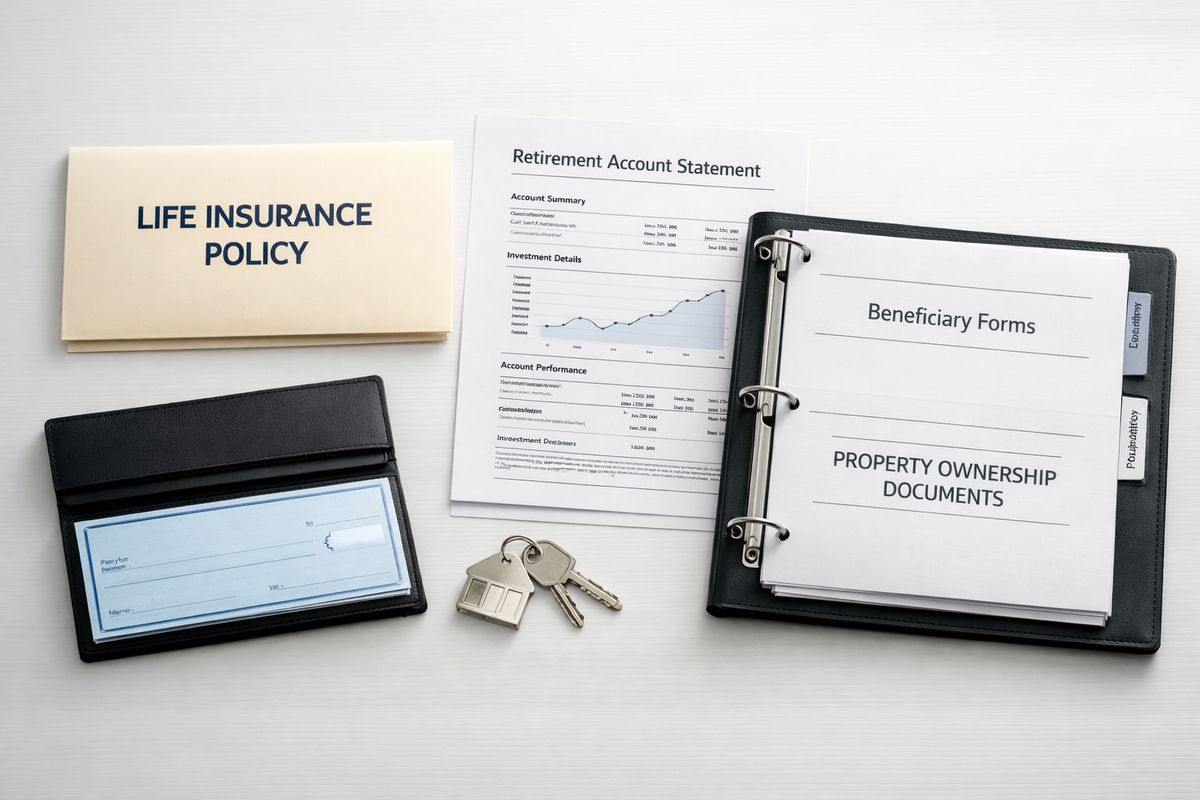
Life insurance policies, retirement accounts, payable-on-death bank accounts, and transfer-on-death designations usually pass directly to the named beneficiary. That transfer often happens regardless of whether you had a will.
So if your IRA names your daughter, that account usually goes to your daughter directly. California intestacy law does not rewrite that beneficiary form after death.
This is why estate plans break down when beneficiary designations are old, missing, or inconsistent. A will cannot fix every account by magic.
Jointly owned property and living trust assets
Some property also passes outside probate because of how it is titled. Joint tenancy, community property with right of survivorship, and assets already held in a living trust often transfer automatically or through trust administration instead of intestacy.
Homes are the clearest example. If your house is held in a trust, the trust terms control. If you own a home and want to understand which assets still end up in probate anyway, that question matters more than most people realize.
Why dying without a will can create real problems
Intestacy is a blunt tool. It gives you a default plan, but not your plan.
That gap creates real stress for families, especially when the estate includes a home, a cabin, or accounts that do not divide neatly.
You Don’t get to choose who inherits
California’s default rules do not protect everybody you care about. An unmarried partner is usually left out. Stepchildren are usually left out unless legally adopted. Close friends, charities, and beloved relatives outside the legal line of inheritance may receive nothing.
That is a hard truth for blended families and long-term unmarried couples, including plenty of households in Lake Tahoe and San Francisco where family life does not fit neatly into the statute book.
The court can choose a guardian for minor children
If you have minor children, a will does more than pass property. It lets you nominate a guardian.
Without that nomination, a court may have to decide who steps in. That does not mean the court chooses randomly, but it does mean you lose the chance to state your preference clearly in advance. For parents, this is one of the strongest reasons not to leave things unfinished.
Probate can take time and add stress
Probate is not just one court date and a signature. It involves filings, notices, deadlines, valuations, creditor issues, and court supervision. During an already painful time, that can slow access to money or property and make basic decisions harder.
If you want to avoid that bottleneck, it helps to compare ways to keep property out of probate in California. The difference can be significant, especially if a house is involved.
Family conflict gets easier to start
Conflict does not always start because somebody is greedy. Often it starts because nobody is sure what you wanted.
A Tahoe vacation property is a good example. One person wants to keep it. Another wants to sell it. Another assumes years of maintenance should count for something. Without clear instructions, small resentments get room to grow.
Special situations that catch people off guard
Some situations look simple until the legal details show up. Then the confusion starts.
Unmarried partners and stepchildren
This is one of the most painful surprises in California estate law. Intestacy generally does not protect an unmarried partner. It also usually does not protect a stepchild unless a legal adoption took place or another planning tool was used.
So even if somebody shared your home, paid bills with you, or helped raise children with you for years, that relationship alone may not create inheritance rights under intestacy.
If you own a business
A business interest can become a mess when no plan is in place. Ownership may need to be valued, transferred, or managed during probate. That can delay decisions, create confusion among family members, and complicate day-to-day operations.
For a small business, even a short period of uncertainty can hurt cash flow, employees, or customer relationships. Estate planning is not just about who inherits. It is also about continuity.
If you own real estate in more than one place
If you own real estate outside California, a second probate proceeding may be required in that other state. So a Bay Area primary residence plus a vacation condo in another state can mean extra cost, extra paperwork, and more delay.
This is one reason many homeowners look closely at trusts. If you are sorting through that choice, it helps to understand how a trust changes the picture for California homeowners.
Common questions about dying without a will in california
A few questions come up again and again because the rules sound simpler than they really are.
Does everything go to your spouse?
No, not always. A surviving spouse usually receives all community property, but separate property may be shared with children or, in some cases, other relatives.
Do your children automatically get everything?
No. Children often inherit when no spouse survives, but if a spouse survives, children may share only in separate property. Community property usually follows a different rule.
Does the state get your property if There’s no will?
Usually no. The state receives property only if no eligible relatives can be found under California’s intestacy laws. That is much less common than people assume.
Can a living trust help you avoid this?
Yes, if it is properly created and properly funded. A living trust lets you choose who receives trust assets and can avoid many of the problems that come with intestacy and probate. The catch is that a trust only controls assets actually placed into it, which is why making sure your trust is fully funded matters so much.
The smart next step if you want to avoid this outcome
If you want to avoid California making these decisions for you, the fix is straightforward: make or update a will, review beneficiary designations, and check how your major assets are titled. If you own a home, have minor children, or want to make things easier for loved ones, a living trust may also be worth serious attention. If you are still comparing options, start with the difference between a will and a trust in real life.
Try one concrete step this week: pull up the deed to your house or log in to one retirement account and check the beneficiary listed there. That one small check often reveals more than expected.
Ready to take the next step? Get in touch with Elaine Andrews at The Andrews Law Firm to discuss your needs, request a personalized quote, and explore the best options for your situation. Whether you need an estate plan, a living trust, or guidance through probate, Elaine can help you move forward with confidence.
Contact us today to schedule your consultation.
Frequently asked questions
What happens if you die without a will and own a house in california?
It depends on how the house is titled. If the house is in your sole name, it may go through probate and pass under intestacy rules. If it is held in joint tenancy, as community property with right of survivorship, or in a living trust, it may pass outside intestacy.
If you are married, does your spouse automatically inherit everything in california?
Not necessarily. A spouse usually receives all community property, but separate property may be split with children or, in some cases, other relatives. The result depends on the family tree and how the property was acquired.
Can your stepchildren inherit if you die without a will in california?
Usually not through intestacy alone. Stepchildren generally do not inherit unless legal adoption occurred or property passes to them through another tool, such as a trust, beneficiary designation, or will.
Does probate always happen if there is no will?
Not always. Probate may be avoided if assets pass by beneficiary designation, joint ownership, or a living trust. But assets owned in your name alone with no automatic transfer feature often still require probate.
Can an unmarried partner inherit from you if there is no will?
Usually no under California intestacy law. That is one of the biggest reasons unmarried couples often need intentional planning, especially if a home or shared finances are involved.
Is a will enough to avoid these problems?
A will is far better than having nothing, but it does not avoid probate by itself. Depending on what you own, a trust, updated beneficiary designations, and correct asset title may be just as important.