
California Estate Law
Estate Planning Cost in California: What You’ll Actually Pay
Estate planning cost California: see what you’ll actually pay for wills, trusts, and probate protection.
Estate planning cost California is one of those topics that gets confusing fast, because the number you see in an ad is rarely the number that tells the full story. If you want to know what you’ll actually pay, and what you’re getting for that money, the answer comes down to scope, complexity, and whether your plan will work in real life when your family needs it.
What estate planning in california usually costs
The real question is not how cheaply you can get a document. It is how much you need to spend to put the right plan in place for your home, your accounts, your family, and your future care decisions.
In California, a basic will often costs a few hundred dollars at the low end if you use an online form or a very limited service. A lawyer-prepared will-based plan usually lands higher. A complete trust-based plan costs more upfront, often by a lot, but that higher price usually reflects more documents, more advice, and more work to help you avoid probate.
If you live in San Francisco, the greater Bay Area, Truckee, or Lake Tahoe, expect pricing to run above the state’s lowest advertised rates. Office overhead, local legal markets, and the fact that many households own valuable real estate all push fees up.
Typical price ranges for the most common estate plans
For a simple California will prepared through an online platform, you may see prices from about $100 to $400. For an attorney-drafted will alone, a common range is roughly $500 to $1,500.
A will plus a durable power of attorney and advance healthcare directive often lands around $800 to $2,000 for one person, depending on how customized the plan is. For a single-person living trust package, a practical California range is often $1,500 to $3,500. For a married couple, a joint or coordinated trust plan often runs about $2,500 to $5,500.
Once you add business interests, rental property, tax planning, special needs planning, or blended family terms, costs can rise into the $5,000 to $10,000-plus range. That sounds like a huge spread, because it is. A simple plan and a custom strategy for a family with multiple properties in the Bay Area are not remotely the same product.
Why california prices can feel all over the map
Here’s the thing: one quote may cover only document drafting, while another includes legal advice, deed preparation, signing support, trust funding instructions, and follow-up revisions. On paper, both may be called a “living trust package.” In real life, one could be a usable plan and the other could be a stack of unsigned PDFs.
That is why the sticker price means very little by itself. Before comparing fees, look at what is actually included, how much attorney guidance you get, and whether the plan is set up to work after signing.
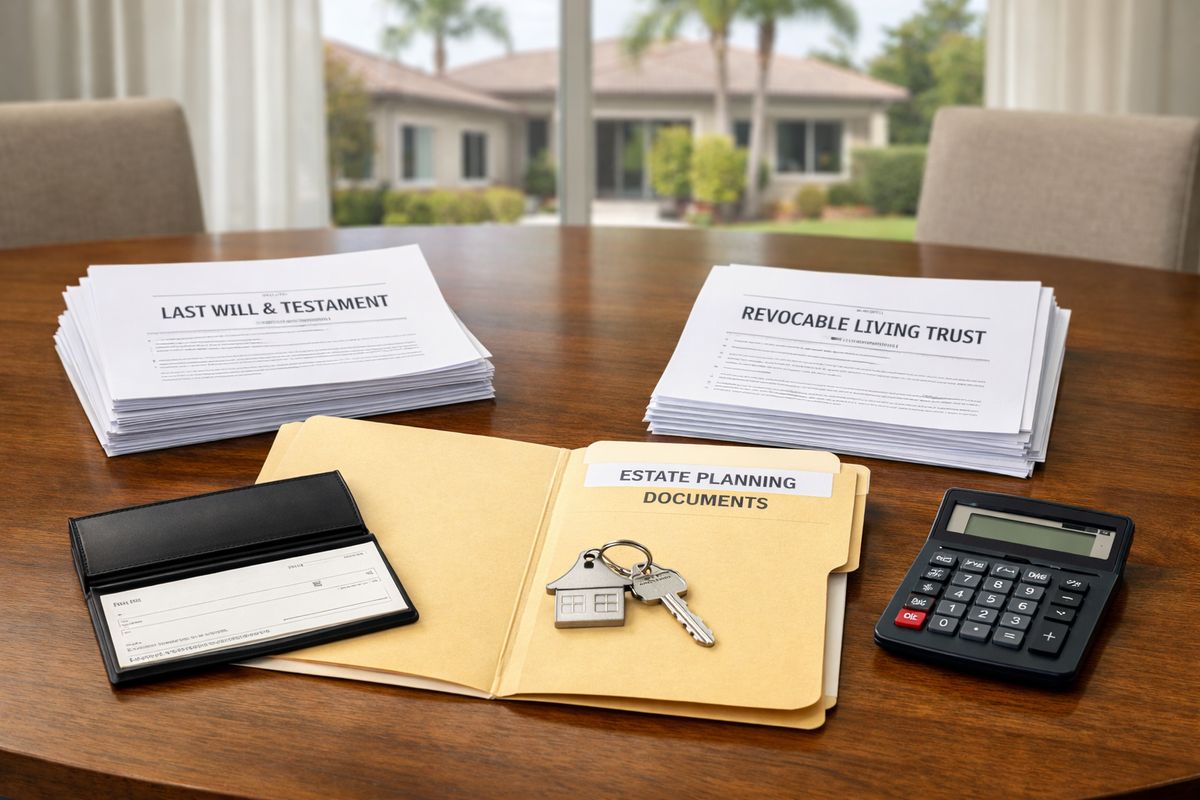
What’s Usually included in an estate plan fee
A fair quote should cover more than paperwork. It should cover coordination, because estate planning works like a set of keys. One missing key can make the whole ring a lot less useful.
Core documents in a basic will-based plan
A basic will-based plan usually includes a last will and testament, which says who inherits property that passes through your estate and who handles the process. It may also name guardians for minor children.
A durable power of attorney for finances lets someone manage financial matters for you if you become incapacitated. An advance healthcare directive names someone to make medical decisions and spells out your care wishes if you cannot speak for yourself.
Those three documents form the backbone of a simple plan. If you are comparing a will-only quote to a more complete will-based plan, make sure those incapacity documents are included. If not, the lower price may not be much of a deal.
What a living trust package usually includes
A living trust package usually includes a revocable living trust, which holds assets during your lifetime and directs how they pass after death without probate for assets properly titled to the trust. It also commonly includes a pour-over will, which acts as a safety net for assets left outside the trust.
You should also expect a certification of trust, which is a short summary used when banks or title companies need proof the trust exists without seeing the full document. Most packages also include a durable power of attorney, advance healthcare directive, and practical trustee instructions.
If you are sorting out the bigger choice between a will and a trust, this breakdown pairs well with a closer look at how those two tools actually differ.
Deeds, funding instructions, and other add-ons
This is where many quotes get slippery. If you own a home, transferring it into the trust usually requires deed preparation and recording. In California, recording fees are often separate, and some firms also charge separately for preparing the deed itself.
Funding instructions matter too. “Funding” means changing title or beneficiary designations so your assets line up with your plan. Without that step, even a beautifully written trust can fail to avoid probate. If you have a family home in Truckee, a rental in Oakland, or a condo in Walnut Creek, ask whether deed work and account retitling guidance are included, and whether those services cover just one property or more than one.
If you want to understand that piece better, it helps to see what happens when assets never make it into the trust.

The biggest factors that change your estate planning cost
Some plans cost hundreds. Some cost thousands. The difference usually comes down to how much thinking and coordination the plan needs.
Your family and asset complexity
If your situation is straightforward, your cost is usually lower. One house, standard bank and retirement accounts, and adult beneficiaries are simpler to plan for than a blended family, young children, or a child with special needs.
Complexity rises when your plan needs staggered inheritance terms, remarriage protection, planning for a vulnerable beneficiary, rental properties, vacation homes, business interests, or property in another state. Each issue adds drafting time and strategy. That is not bloat. That is the work.
Where you live in california
Legal fees tend to be higher in San Francisco and the broader Bay Area than in lower-cost parts of California. The same often holds true in wealth-heavy pockets of Northern California, including Lake Tahoe and Truckee, where homes and second homes increase planning needs.
Location does not just affect office rent. It also affects what lawyers typically see. In higher-value markets, plans often involve real estate coordination, tax awareness, and family wealth transfer concerns that require more than a cookie-cutter form.
Attorney experience and service model
A boutique firm with deep estate planning experience may charge more than a high-volume flat-fee practice. An hourly firm may charge less at the start but more by the end if the scope keeps expanding. Online legal services cost less upfront, but the catch is obvious: you are buying forms, not judgment.
Experience matters most when the plan is not standard. If your family dynamics are calm and your assets are simple, you may not need the priciest option in town. If conflict is likely, or if your estate includes business or property complications, higher-level advice can save much more than it costs.
How much tax or business planning you need
Most households do not need advanced tax planning. But if you own multiple properties, have substantial wealth, expect estate tax exposure, or want a succession plan for a company, fees rise because the documents and strategy become more layered.
Business planning often means aligning operating agreements, buy-sell terms, ownership transfers, and successor authority with your estate plan. That is a different level of project from naming beneficiaries and signing a trust.
Flat fee, hourly, or DIY: how the pricing models compare
The pricing model matters almost as much as the price itself, because it changes how predictable your bill will be.
Flat-fee estate planning
Flat fees are common for wills, trusts, and standard estate planning packages. For most households, this is the easiest model to budget for because you know the cost before the work begins.
The smart move is to ask what the flat fee actually includes. Does it include drafting, one or two rounds of revisions, deed transfer for your home, a signing meeting, and funding instructions? If yes, you can compare it fairly to another quote. If not, you may be comparing apples to a single orange.
Hourly billing and when it shows up
Hourly billing often appears when the work is unusually complex or open-ended. Trust amendments, business succession planning, probate matters, and trust administration after death commonly fall into this category.
The risk with hourly work is fuzzy scope. A matter that starts with “just a few updates” can turn into a larger bill if your documents are old, your assets changed, or your family situation became more complicated over time.
Online forms and DIY estate plans
Online forms and software are the cheapest way in. For a very simple situation, that can be tempting. But the lower upfront cost comes with real risk if documents are incomplete, signed incorrectly, or never funded.
California planning is not just about having a trust document. It is about whether your home, accounts, and backup documents are coordinated. If you are leaning toward a low-cost route, at least understand which property can still end up in probate anyway.
Will or trust: which choice changes the total cost most?
This is the decision that changes the economics the most, because the cheaper option at signing is not always the cheaper option for your family later.
What a will usually costs upfront
A will usually costs less upfront, sometimes much less. That is why many families start there. If you are renting, have modest assets, or fall into a category where a simpler plan fits, the lower entry price can make sense.
For some households, a will really is enough. If that is the question on your mind, it helps to review when a simpler plan can still do the job.
Why a trust usually costs more at the start
A trust usually costs more because it includes more moving parts. You are not just paying for one document. You are paying for a trust, a backup will, incapacity documents, certifications, funding instructions, and often deed work.
You are also paying for probate-avoidance planning. If you own California real estate, that matters. A trust-based plan can feel like paying more now to avoid a bigger mess later, which honestly is exactly what it is.
The real cost of probate in california
For many homeowners, this is where “cheap” planning stops being cheap. California probate can involve court costs, mandatory notices, appraisals, attorney fees set by statute in many cases, executor fees, and long delays before assets are fully distributed.
There is also the cost nobody advertises: time, stress, and lost privacy. Probate filings become part of the public record, and the process often moves slowly. If you want a clearer picture of the delay side, take a look at how long families often wait for probate to finish. And if your goal is to sidestep that process, it helps to understand the practical ways people do that in California.

Hidden estate planning costs to watch for
Some costs are normal. Some are signs that a cheap quote is about to get expensive.
Consultation fees, deed fees, and recording costs
Some firms charge for the initial consultation, while others apply that amount toward the final fee. Deed preparation may be included, or billed separately per property. Recording fees are usually separate because they are paid to the county.
Those extra charges are not automatically a problem. The problem is surprise. A clean quote tells you exactly which fees are legal filing costs, which are attorney fees, and which depend on how many properties need transfer work.
Amendment and update fees
Plans need updates after major life changes. Marriage, divorce, a new child, a move, a home purchase, or the death of a named fiduciary can all trigger revisions.
Some lawyers include a short revision window after signing. Later updates may be billed as a flat amendment fee or hourly. Minor changes may cost a few hundred dollars. Larger trust amendments or restatements can cost much more, especially if the plan is old or poorly drafted.
Funding help, notarization, and document storage
Funding support is a common extra. Some packages include written instructions only. Others help with account retitling or beneficiary review. That difference matters a lot.
Notary charges may or may not be included. Some firms include supervised signing, while others send you out to handle notarization yourself. You may also see ongoing maintenance programs, document storage portals, or subscription-style update plans. Some are useful. Some are just recurring fees dressed up as peace of mind.
What different california households can expect to pay
Abstract price ranges are helpful up to a point. It is easier to place yourself in the right lane.
If you’re a homeowner with one house and simple accounts
If you own one California home, have standard checking, savings, retirement accounts, and straightforward beneficiaries, a trust-based plan often falls in the lower-middle end of attorney pricing. A common range is around $2,000 to $4,000, though Bay Area pricing can push higher.
The main goal here is usually probate avoidance and incapacity planning. If your home is the biggest asset you own, that goal matters more than shaving a few hundred dollars off the setup cost.
If you have young kids or a blended family
Costs usually rise when your plan needs guardian nominations, age-based inheritance rules, separate shares for children from different relationships, or protections in case of remarriage after death.
This kind of planning needs more thought because the default rules may not match what you want. If you have concerns about what happens without a clear plan, it is worth understanding how California decides inheritance when no valid will controls.
If you’re retired with real estate or larger assets
Retirement often brings more, not less, planning work. Multiple properties, beneficiary coordination, retirement account review, and trust updates after a move all add time and cost.
If you own a primary home plus a second home near Tahoe, or sold a longtime Bay Area house and bought elsewhere, expect your plan to need careful deed and title coordination. That usually means a higher fee than a first-time basic trust package.
If you own a business
Business owners should expect additional cost for succession terms, ownership transfer planning, and document coordination. Your estate plan needs to line up with corporate or LLC records, shareholder agreements, and any buy-sell terms already in place.
That extra expense is usually worth it, because a business is where confusion gets expensive fast. If your authority to act, ownership rights, or transition plan is vague, the fallout can hit both your family and the business itself.
When paying more makes sense, and when it doesn’t
Higher cost is not always overpaying. Lower cost is not always savings. The trick is knowing which is which.
Signs a higher fee may be worth it
A higher fee may be justified if your family situation could lead to disputes, if a beneficiary has special needs, if you own several properties, if your wealth raises tax planning issues, or if your business needs a real succession plan.
In those cases, custom drafting and careful advice are not luxuries. They are the product.
Red flags on prices that seem too low
Extremely low prices often mean stripped-down templates, heavy upsells, no deed work, no funding guidance, or missing incapacity documents. Sometimes the headline price covers only one document and leaves out everything that makes the plan actually usable.
A trust without funding help is a classic example. On paper, you bought a trust. In practice, you bought homework.
Red flags on prices that seem too high
An expensive quote is not automatically better. High fees should come with a clear scope, thoughtful customization, revision flexibility, signing support, and a practical funding process.
If two quotes solve the same problem, the larger bill should come with a real reason. Prestige alone is not a reason.
How to compare estate planning quotes without getting lost
You do not need to become a legal expert to compare estate planning quotes well. You just need to slow down and check what is inside the package.
Questions to ask before you hire anyone
Ask what documents are included, whether deed transfer for your home is covered, how many revisions you get, whether signing is supervised, and what future updates typically cost. Ask whether the quote includes funding instructions and whether help with retitling accounts is available.
Also ask the simplest question of all: what is not included? That one tends to clear the fog fast.
What “included” should mean in plain english
“Included” should mean your plan is drafted for your situation, reviewed with you, ready to sign properly, and coordinated well enough to work when needed. It should not mean you receive generic forms and a checklist and are left to figure out the rest.
A complete plan should also account for the assets that matter most, especially your home. If the package ignores title work or beneficiary coordination, it may not be complete in any useful sense.
The best next step before you spend anything
Before you ask for quotes, gather a short list of what you own, who you want involved, and what worries you most. Include your home, major accounts, business interests, life insurance, retirement assets, and the people you want making decisions if you cannot.
Then get one clear quote for the level of planning you actually need, not the cheapest document you can find. Start by writing down your house, your key accounts, and your decision-makers on one page. That one small step makes every conversation after that easier.
Frequently asked questions
How much does a basic estate plan cost in california?
A basic will-based estate plan in California often costs about $800 to $2,000 when it includes a will, financial power of attorney, and healthcare directive. Online options may cost less, but attorney-prepared plans usually include more guidance and fewer chances for mistakes.
How much does a living trust cost in california?
A single-person living trust package often runs about $1,500 to $3,500. A married couple’s trust plan often lands around $2,500 to $5,500, with higher pricing common in the Bay Area and for more complicated estates.
Is a trust worth the extra cost over a will?
For many California homeowners, yes. A trust usually costs more upfront, but it can help avoid probate, reduce delay, and keep matters private if assets are properly transferred into the trust. The upfront savings of a will can disappear quickly if your estate later goes through probate.
What costs are often not included in an estate planning quote?
Common extras include deed preparation, county recording fees, later amendments, funding assistance, notarization, and document maintenance programs. A quote is only useful if it clearly separates attorney fees from outside filing or recording costs.
Can you do estate planning online for less?
Yes, but lower cost often means less guidance. Online plans can work for very simple situations, but mistakes with signing, trust funding, or California-specific requirements can create bigger costs later. That risk goes up if you own real estate, have young children, or have a blended family.
How often should you expect to update your estate plan?
A good rule is to review your plan every few years and after major life changes, such as marriage, divorce, a birth, a death, a move, retirement, or buying property. Some updates are minor and inexpensive. Others require more substantial revisions.
Ready to take the next step? Get in touch with Elaine Andrews at The Andrews Law Firm to discuss your needs, request a personalized quote, and explore the best options for your situation. Whether you need an estate plan, a living trust, or guidance through probate, Elaine can help you move forward with confidence.
Contact us today to schedule your consultation.