California Estate Law
Estate Planning for Solo Agers: Aging Without Family Nearby
More Californians are reaching their later years with no spouse or adult children to step in. Planning early is what keeps those decisions out of a courtroom.
More Californians than ever are reaching their later years without a spouse, a partner, or adult children able to help. Some never married. Some outlived a spouse. Some have children who live across the country or are not in a position to step in. The shared reality is the same: there is no one whose involvement the system simply assumes.
Aging alone does not have to mean fending for yourself. But it does mean the safety net has to be built deliberately, in advance, and in writing—because California’s default answer for someone who becomes incapacitated with no documents in place is a court proceeding, not a family member.
Here is what solo agers in Northern California should have in place, and why the timing matters more than the paperwork.
Why the Risk Is Different When You Are Aging Alone
Most estate planning assumes a fallback. A spouse notices the missed payments. An adult child drives to the hospital and answers the doctor’s questions. Even when the documents are imperfect, someone with an obvious stake shows up and sorts it out.
Solo agers do not have that fallback, and the consequences surface at the worst possible moment. A fall, a stroke, or a sudden diagnosis can leave no one with legal authority to pay your mortgage, talk to your physician, or decide where you receive care. Banks freeze access. Providers cite privacy rules. Nothing moves.
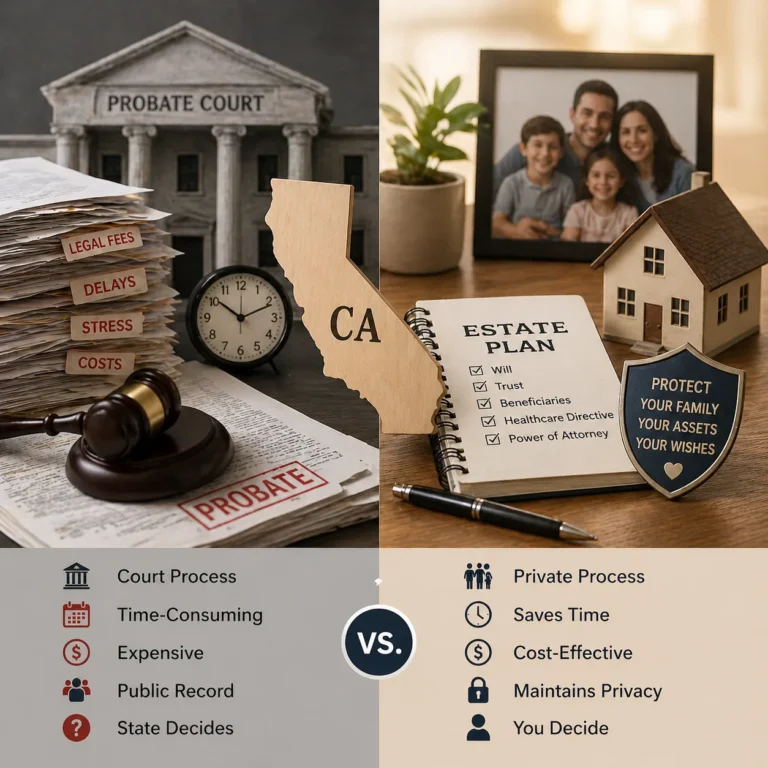
At that point the only remaining path is a conservatorship—a California probate court proceeding in which a judge appoints someone to manage your person, your finances, or both. It is public, it is expensive, it continues under court supervision for the rest of your life, and the person appointed may be a stranger. Every document described below exists to make that proceeding unnecessary.
The Documents That Keep the Court Out of Your Life
For solo agers, the incapacity documents matter more than the inheritance documents. These are the ones that determine who acts for you while you are still alive.
- Advance health care directive. California’s directive does two jobs in one document: it appoints an agent to make medical decisions for you and records your own instructions about treatment, resuscitation, and end-of-life care. Without it, no one has standing to direct your care.
- Durable power of attorney for finances. This authorizes someone to pay bills, manage accounts, handle insurance, and deal with property if you cannot. Signed while you have capacity, it is the single document most likely to prevent a conservatorship.
- Revocable living trust. A trust lets a successor trustee step in and manage assets immediately on incapacity or death, with no probate and no court oversight. For solo agers it does double duty—it is both an incapacity tool and the reason your estate never becomes a public court file.
- HIPAA authorization. Medical privacy law can block even the people you have named from getting information. A separate authorization ensures your agents and chosen contacts can actually receive it.
- Nomination of conservator. California law lets you nominate, in advance, who a court should appoint if a conservatorship ever does become necessary. Courts give that nomination priority. It is the backstop behind every other document.
Name a first choice and at least two alternates for every role. A plan that depends on one person is a plan that fails when that person moves, declines, or predeceases you.
Choosing Agents When There Is No Obvious Family Member
This is the question that stops most solo agers from finishing a plan: there is no obvious name to write down. The answer is that the role does not have to go to a relative, and in many cases should not.
- A trusted friend or a younger relative. Consider whether they live close enough to act, whether they are comfortable with the responsibility, and whether they will still be able to serve in fifteen years.
- A licensed professional fiduciary. California licenses professional fiduciaries through the Professional Fiduciaries Bureau, and they can serve as agent, trustee, or conservator. They are bonded, regulated, and neutral—which also removes the burden from a friendship.
- A bank or trust company. Corporate trustees do not move away, become ill, or lose interest. They are typically a better fit for larger estates given their fee structures.
- Different people for different roles. The person best suited to sit with your doctors is rarely the person best suited to manage your investments. Splitting the roles is common and entirely permissible.
Whoever you choose, tell them. An agent who learns of the appointment during an emergency is at a serious disadvantage, and one who declines at that moment leaves you with no one.
Housing Decisions Belong in the Plan
Where you intend to live is a planning decision, not just a lifestyle one, and it deserves to be made before a health event forces it. Aging in place with paid support, moving to a continuing care retirement community, or joining a co-housing arrangement each carry different costs, different levels of daily contact, and different long-term commitments.
Location adds a further layer for those of us in the Sierra Nevada. Winter access, distance from specialized medical care, and the practical difficulty of arranging in-home help in a mountain community all affect whether aging in place is realistic over a twenty-year horizon. Continuing care retirement communities in California operate under state-regulated continuing care contracts, and those contracts should be reviewed by an attorney before signing—they are long-term financial commitments, not leases.
Deciding in advance, and recording the preference where your agents can find it, means the choice stays yours rather than being made under pressure by someone reading your file for the first time.
Building a Documented Circle of Support
Legal authority handles the crisis. What prevents the crisis is a support network, and for solo agers it works best when it is written down rather than assumed. A short circle-of-support document listing who does what, with current contact information, gives your agents somewhere to start.
Practical arrangements worth building into the routine include:
- Regular check-ins with a friend, neighbor, or community organization, on a schedule specific enough that a missed contact is actually noticed.
- A geriatric care manager to coordinate medical appointments, evaluate care needs, and act as a professional set of eyes on your situation.
- A daily money manager or licensed fiduciary to handle bill payment and recordkeeping—an early safeguard against both missed obligations and financial elder abuse, which targets isolated older adults disproportionately.
- A current list of your professionals, accounts, medications, and document locations, kept somewhere your agents can reach without a scavenger hunt.
Paying for Care Over a Long Horizon
Solo agers are more likely to need paid care, and to need it sooner, because there is no spouse or adult child absorbing the unpaid work. Long-term care insurance, life insurance with a long-term care rider, and a realistic drawdown strategy should all be evaluated well before care is needed.
Medi-Cal planning has changed meaningfully in California and is worth revisiting if your understanding is more than a few years old. As of January 1, 2024, California eliminated the asset limit for non-MAGI Medi-Cal, which removed a barrier that had previously disqualified many middle-income older adults from long-term care coverage.
California also limits Medi-Cal estate recovery to assets that pass through probate. Property held in a properly funded revocable living trust, or transferring by beneficiary designation, generally falls outside the recovery estate. For a solo ager, this is a significant planning point: the same trust that avoids probate and manages your affairs during incapacity may also protect what remains for the people and causes you chose.
Taking the First Step
Solo agers who document their preferences, name their decision-makers, and build a real support network keep control of their own later years. Those who wait hand the decisions to a court that has never met them.
The documents themselves are not complicated. The work is in thinking clearly about who will act, in what order, and under what circumstances—and then getting it signed while it is still entirely your choice to make.
Andrews Law Firm helps solo agers throughout Northern California, including Truckee, Tahoe City, and the surrounding Sierra Nevada region, build plans that protect independence rather than limit it. Contact us to schedule a consultation.