California Estate Law
Marriage, Divorce, and Remarriage: Updating Your California Estate Plan
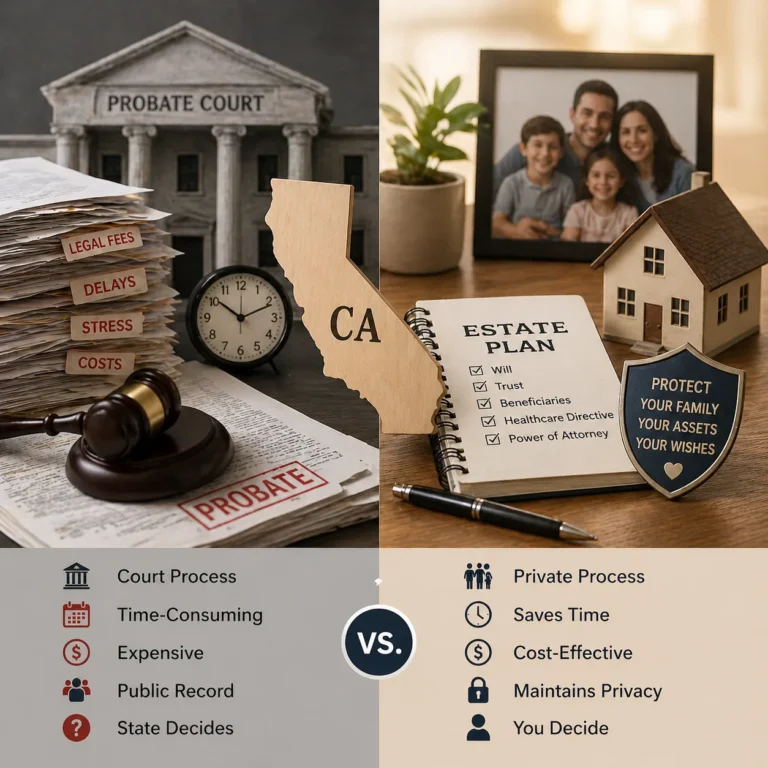
Each major life transition reshapes the legal framework governing your estate. Without timely updates, California's default rules apply—and they rarely match what you would have chosen.
Major life transitions—marriage, divorce, remarriage—do not just change your personal circumstances. They change the legal framework that governs your estate. Rights are created, old provisions are voided, new competing interests emerge, and the people who should inherit from you may shift entirely.
Most Californians update their estate plan once and assume it will hold. But each of these transitions requires a deliberate, thorough review—because when the plan is left unchanged, the law applies its own default rules, and those rules rarely match what you would have chosen.
How Marriage Affects Your California Estate Plan
California is a community property state, which means that most assets acquired during a marriage—income, retirement contributions, real estate purchases, investment accounts—are owned equally by both spouses regardless of whose name is on the title or account. This classification happens automatically and has significant consequences for how your estate will be distributed.
A surviving spouse also holds legal rights that can override provisions in an outdated estate plan. If your documents do not reflect your current marital status, conflicts can arise between what your plan says and what the law requires.
After getting married, the following updates are typically needed:
- Revise any existing revocable living trust to reflect your married status and include your spouse in the distribution structure.
- Update beneficiary designations on retirement accounts, life insurance policies, and payable-on-death bank accounts—these do not update automatically.
- Review your will and powers of attorney to confirm they align with your current wishes and relationship.
- Consider a transmutation agreement or separate property documentation if either spouse brought significant assets into the marriage that should remain separate.
What Divorce Does to Your Existing Estate Plan
California law automatically voids provisions naming a spouse as a beneficiary, trustee, or agent in a will or revocable trust once a divorce is finalized. This offers some protection, but the automatic revocation is narrower than most people assume.
Beneficiary designations on IRAs, 401(k) plans, and life insurance policies are governed by federal law and contract terms—not California’s automatic revocation rules. In many cases, these designations survive divorce and continue paying out to a former spouse unless explicitly changed. Divorce decrees that require updates do not make those updates happen; only a new designation form filed with the account or policy does.
A complete estate plan review after divorce should include:
- Rewriting the trust entirely to remove all references to the former spouse and establish a clean legal framework going forward.
- Filing updated beneficiary designations on every retirement account, insurance policy, and financial account—even those you believe were addressed in the divorce settlement.
- Reviewing all property titles to confirm ownership is correctly documented after the division of community property.
- Replacing the former spouse as executor, successor trustee, or agent under any power of attorney for finances or healthcare.
The Added Complexity of Remarriage
Remarriage introduces competing interests that require careful, deliberate planning. Without clear documentation, a new spouse’s legal rights may inadvertently override intended inheritances for children from a prior relationship. Alternatively, failing to properly provide for a new spouse can create marital tension and potential legal disputes.
California’s community property rules apply to post-remarriage income and assets immediately upon remarriage. This means new income, jointly purchased property, and retirement contributions begin accumulating as community property—alongside whatever separate assets you brought into the marriage.
Blended family planning typically involves:
- A prenuptial agreement to define clearly which assets each spouse owns separately and which will be treated as community property going forward.
- Separate inheritance trusts for children from prior relationships, which hold and protect their intended inheritance independent of the new marriage.
- Carefully updated beneficiary designations that account for new spousal rights under federal retirement plan rules.
- Clear succession provisions in your trust that balance the interests of a surviving spouse and biological children without ambiguity.
When and How to Review Your Plan
The most effective time to review your estate plan is before each transition, not after. A review before marriage allows you to set clear expectations and protect separate property. A review during divorce proceedings ensures that interim decisions are consistent with your long-term goals. A review before remarriage allows you to address blended family dynamics before new legal rights attach.
Every document in your estate plan must work together. A trust that conflicts with a beneficiary designation, or a will that contradicts a power of attorney, can create exactly the disputes a plan is supposed to prevent.
Leaving an outdated estate plan in place is not a neutral decision. It is a decision to let California’s default laws determine what happens to your assets and who speaks for you in a crisis. Andrews Law Firm helps individuals and families in Truckee, Tahoe City, and throughout the Sierra Nevada region keep their estate plans current at every stage of life. Contact us to schedule a consultation.