California Estate Law
How to Transfer a House to a Trust in California
Transfer house to trust in California with easy steps to protect your home and loved ones.
If you want to transfer house to trust in California, the hard part usually is not the idea. It is the paperwork. A house in Truckee, Tahoe, or the Bay Area can be one of the biggest assets in your plan, and one wrong name, missing legal description, or unrecorded deed can leave it sitting outside the trust when it matters most.
What you’ll need before you transfer your house to a trust
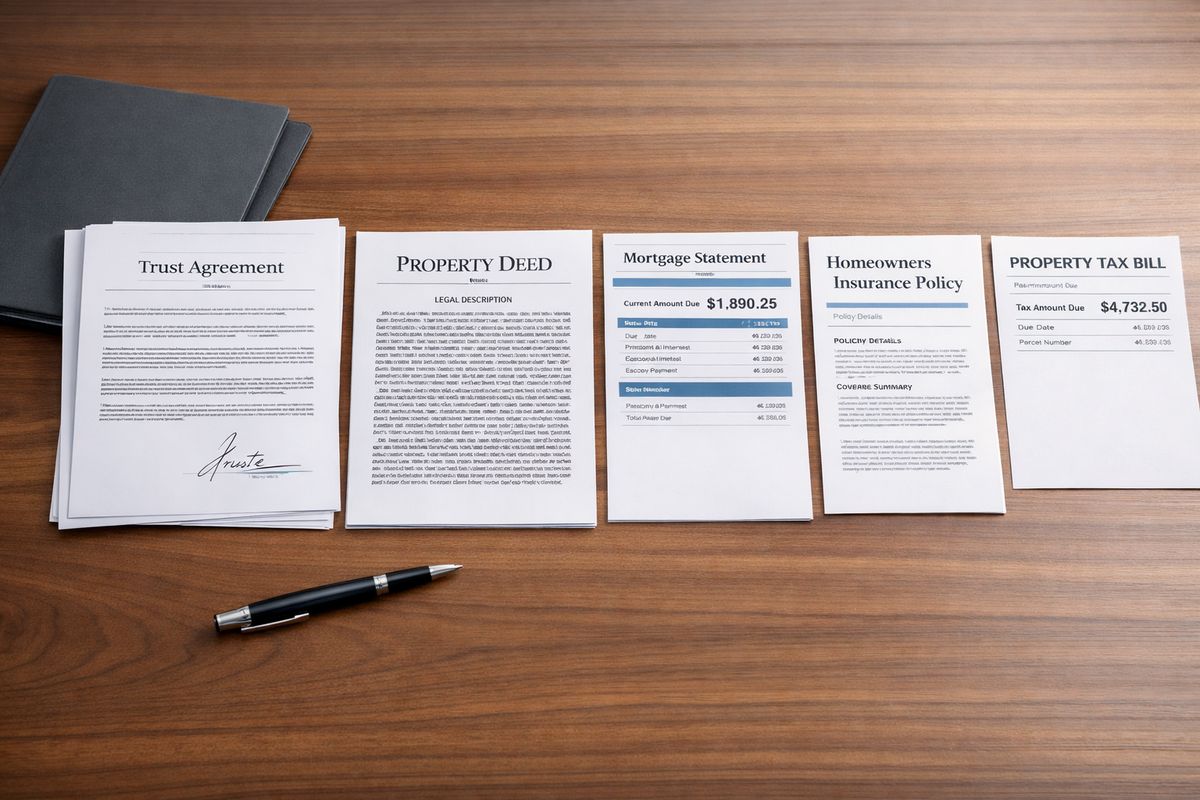
Getting organized first makes the rest of this much easier. Think of it like packing for a trip: if your wallet, keys, and charger are already on the counter, you leave on time. If not, you waste half an hour hunting around.
Your signed trust document
Your trust has to exist before your house can go into it. That means you need the signed trust document, not just draft pages or a summary. Pull the exact trust name, the trust date, and the current trustee name directly from that document and copy it exactly.
Those details matter more than most people expect. If the trust says “The Johnson Family Trust dated March 12, 2024,” the deed should not shorten, rewrite, or improvise that wording.
Your current deed and vesting information
Next, get a copy of your current deed. This shows how title is held right now, sometimes called vesting. It also includes the legal description, which is the formal property description used in recorded documents.
Do not rely on the street address alone. “123 Main Street” helps the mail carrier. The legal description is what helps the county know exactly what land is being transferred.
Loan, tax, and insurance details
Pull your mortgage statement, homeowners insurance policy, and most recent property tax bill. Most transfers into a revocable living trust do not change day-to-day ownership in any practical sense, but skipped details can create annoying follow-up problems.
For example, if insurance still names only you individually after title changes, or if the assessor gets a deed with no supporting form, you can end up spending extra time fixing records that should have been clean from the start.
A quick note on california and local recording offices
In California, deeds are recorded at the county level. That means the recorder’s office in Placer County may have slightly different submission preferences than Nevada County, El Dorado County, Alameda County, or San Francisco.
The core process is the same, but fees, cover sheet requirements, and recording methods can vary. Always check the recorder for the county where the property sits, not where you happen to live or get mail.
Step 1: confirm that your trust is ready to receive the house
Before you touch the deed, make sure the trust is actually ready. A trust that exists on paper but is missing the right details can cause cleanup later.
- Pull the signed trust.
- Locate the exact trust name and date.
- Confirm the current trustee.
- Make sure this is the trust you want owning the house.
Verify the exact trust name and date
Copy the trust name and date exactly as written. One missing word can be enough to create confusion in future title work or trust administration.
Checkpoint: compare the trust heading on the document to the way you plan to write it on the deed. If they do not match character for character in substance, fix that before moving on.
Confirm the current trustee
In most California trust transfers, title goes to you as trustee of your trust, not to the trust as a floating concept by itself. The trustee is the person legally holding and managing title for trust property.
So the grantee language usually names a person or people, followed by “as trustee” of the named trust. That structure matters because county records need an actual title holder.
Check whether the property should go into this trust
Most homeowners doing estate planning are transferring a home into a revocable living trust. That is different from transferring property into an LLC, business trust, or irrevocable trust.
If your goal is to keep the home aligned with the rest of your estate plan and avoid probate, make sure the property belongs in this trust and not somewhere else. If you want a broader picture of why this step matters, it helps to understand what happens when a trust never gets properly funded.
Step 2: review how your house is titled right now
Your new deed should transfer exactly what you currently own, in the way you currently own it. That starts with reading the current deed carefully.
- Find the latest recorded deed.
- Identify the current vesting language.
- Confirm the legal description and APN.
- Check for co-owners.
Identify the vesting on the current deed
Look for wording such as sole owner, joint tenants, community property, or community property with right of survivorship. Those words are not filler. They describe the ownership structure being transferred.
If title is held by spouses together, both names usually need to appear correctly in the new deed. If title is shared with someone outside the trust plan, stop and review the implications before moving forward.
Confirm the legal description and assessor parcel number
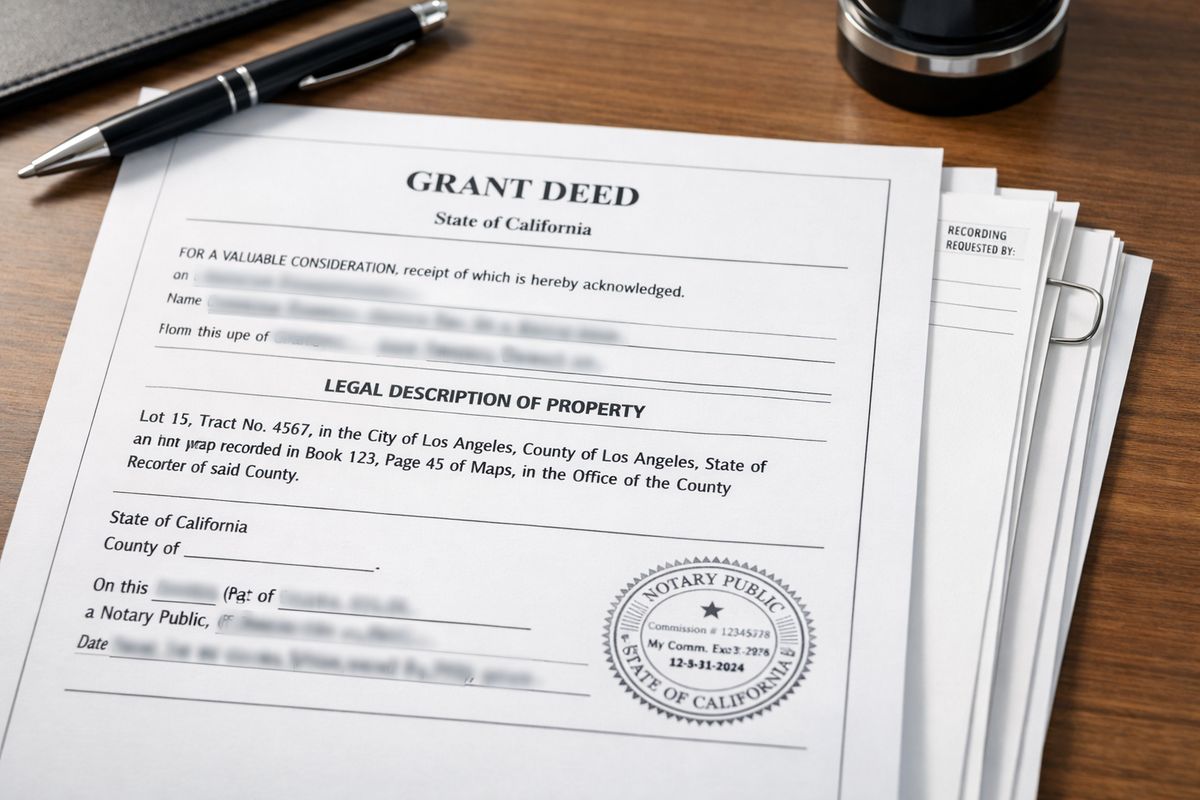
The legal description may be a lot longer than expected. It might refer to a lot and block, tract map, or metes-and-bounds description. Copy it exactly from the current deed.
The assessor parcel number helps identify the property for county purposes, but it is not a substitute for the legal description. Use both where the forms call for them.
Check for co-owners or prior transfers
Make sure every current owner who needs to sign is identified up front. That includes a spouse, family member, or anyone else on title.
If title has changed recently because of refinancing, marriage, divorce, or inheritance, confirm you are working from the most recent recorded deed. That sounds obvious, but it is a common place people trip.
Step 3: choose the right california deed for the transfer
Now you need the right deed form. Online templates make this look easier than it is, and that is where people get into trouble.
- Identify the deed type commonly used for your transfer.
- Gather any county companion forms.
- Make sure the deed matches the purpose of the transfer.
When a grant deed is commonly used
In California, a grant deed is commonly used to transfer a house from you individually to you as trustee of your revocable living trust. In plain English, it moves title from one legal capacity to another.
That is why many estate plans use it for trust funding. If you want a side-by-side walkthrough focused just on the deed itself, this guide on moving title into a living trust is a useful companion.
When another deed type may come up
A quitclaim deed sometimes appears in trust transfers, but it is not automatically the best choice just because it is easy to find online. Different deed types carry different legal effects.
The catch is that “simple” does not always mean “right.” If the title history is messy or ownership is unusual, the wrong deed can create extra work later.
Include preliminary change of ownership information
Many California counties expect a Preliminary Change of Ownership Report with the deed. This form helps the assessor understand what happened and, just as important, what did not happen.
For a transfer into your own revocable trust, the paperwork should make clear that this is not a sale and that beneficial ownership is staying the same.
Step 4: prepare the deed correctly
This is the heart of the process. Small mistakes here can ripple outward into title, tax, and estate administration issues later.
- Enter the grantor exactly as shown on current title.
- Name the grantee as trustee of the trust.
- Add the full legal description.
- Complete tax and mailing sections.
- Review every line before signing.
List the grantor and grantee the right way
The grantor is the current owner. The grantee is the trustee of the trust receiving title. In many cases, that means one version of you is transferring the property to another version of you wearing the trustee hat.
That odd paperwork shift is normal. The names and capacities just need to be written clearly and consistently.
Add the full legal description
Use the full legal description from the prior recorded deed. Do not shorten it, summarize it, or replace it with the property address.
If the old deed includes an attached exhibit, the new deed should include it too. A long legal description is annoying, but a missing one is worse.
Complete the documentary transfer tax wording
Most trust transfers involving no sale use exemption wording showing that no documentary transfer tax is due because beneficial ownership is not changing. Counties often have accepted wording patterns for this.
This section is not the place to guess. Use language appropriate to the transfer and the county form requirements.
Include the mailing and recorder information
Fill in the “return to” and mailing information carefully. This tells the county where to send the recorded deed after processing.
Checkpoint: before signing, scan for blank spaces, misspelled trust names, wrong dates, or missing attachments. Five quiet minutes here can save a month of cleanup.
Step 5: handle california property tax and reassessment forms
This step feels tedious, but it protects you from bigger headaches. A clean deed package helps the assessor understand the transfer correctly.
- Complete the Preliminary Change of Ownership Report.
- Identify the trust-related exclusion that applies.
- Watch for facts that could change the analysis.
Fill out the preliminary change of ownership report
This form tells the assessor what changed in the record and whether the transfer should trigger reassessment review. For a transfer into your own revocable trust, the answer usually shows that beneficial ownership remains the same.
Be accurate and consistent with the deed. If the deed says one thing and the form suggests another, expect delays or questions.
Understand why most revocable trust transfers do not trigger reassessment
In California, placing your home into your own revocable trust usually does not count as a change in ownership for reassessment purposes, because you still control and benefit from the property.
That is the good news. The better news is that this is one of the main reasons homeowners use revocable trusts in the first place, along with keeping the home out of probate. If you want the bigger picture, this explanation of how trust planning helps sidestep probate in California connects the dots.
Watch for exceptions with LLCs, rental property, or ownership changes
Extra caution makes sense if the property is a rental, mixed-use, recently transferred, or tied to a business structure. The same goes for ownership changes involving family members or non-trust co-owners.
If beneficial ownership is actually changing, the tax analysis can change too. That is where a “simple transfer” stops being simple.
Step 6: sign and notarize the deed
A deed is not ready for recording until it is signed and notarized properly. This is the formal handoff.
- Sign as current title appears.
- Use a California notary.
- Review the complete notarized deed.
Sign exactly as your current title appears
Match the ownership shown on the current deed as closely as possible in the signature block and signing capacity. If two owners are on title, both usually need to sign.
If your name appears with a middle initial, suffix, or trust-related wording on current title, do not casually rewrite it on the new deed.
Use a california notary properly
Take the unsigned deed to a California notary unless instructed otherwise by the notary. Bring valid identification and make sure the notarial acknowledgment is completed in a form acceptable for recording.
The notary is not there to correct the deed for you. The notary verifies identity and acknowledgment, not legal accuracy.
Review the finished document before recording
After notarization, read the whole deed one more time. Check names, trust date, legal description, mailing address, and attached pages.
Checkpoint: if anything is wrong, fix it before recording. Recording the wrong deed just creates a second project.
Step 7: record the deed in the county where the property is located
Recording is what makes the transfer part of the public record. Until this happens, the deed is just signed paper.
- Find the correct county recorder.
- Submit the deed and required forms.
- Pay the fee.
- Save the recorded copy.
Find the correct county recorder’s office
Record in the county where the house sits. A home near Lake Tahoe may be in Placer, Nevada, or El Dorado County, even if your mailing address is somewhere else.
That local detail matters. County lines around mountain communities can be less obvious than people expect.
Pay recording fees and submit required forms
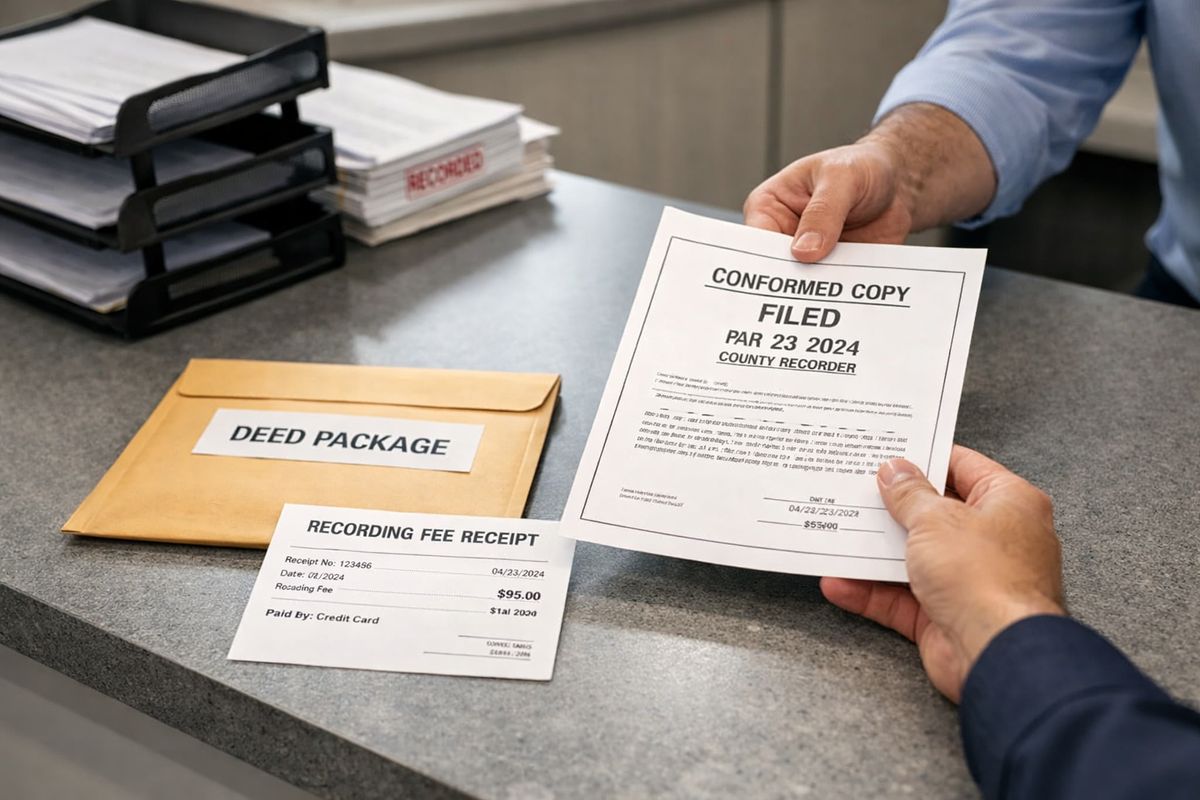
Submit the deed, the Preliminary Change of Ownership Report if required, and any county-specific cover materials or fees. Some counties allow in-person delivery, mail-in recording, or eRecording through approved services.
Check current fee schedules before submitting. Rejected recordings usually come down to missing forms, unpaid fees, or formatting problems.
Keep a conformed copy for your records
Once recorded, keep the stamped or conformed copy with your trust papers. Save a digital copy too.
This recorded deed is your proof that the house was actually transferred. That matters more than the unsigned draft sitting in a folder.
Step 8: update related records after the deed is recorded
Recording finishes the transfer, but not the cleanup. A funded trust works best when the surrounding records match.
- Notify insurance if needed.
- Check mortgage servicing records.
- Update your estate planning asset list.
Notify your homeowners insurance carrier
Contact your carrier and ask whether the trust or trustee should be added as an additional insured or interested party. Policies vary, and this is an easy update to miss.
You want coverage lined up with title, especially if a claim ever comes up.
Check with your mortgage servicer if needed
For an owner-occupied home transferred into a revocable living trust, federal law often protects against due-on-sale problems in this setting. Even so, it is smart to keep statements, escrow records, and account notes accurate.
If you are also reviewing the rest of your plan, this is a good moment to look at which assets belong inside your trust and which do not.
Update your estate planning asset list
Mark the property as trust-owned in your internal asset list or trust schedule. That way your documents tell the same story.
A trust is only as useful as its funding. If you have ever wondered why estate plans fail in practice, a lot of it comes down to assets never being moved where the paperwork said they should go.
Step 9: double-check that the house is actually funded into the trust
This last review is worth doing. Plenty of people sign documents and assume the job is done when it is only half done.
- Review the recorded deed.
- Match it to the trust records.
- Store everything where it can be found later.
Verify the recorded deed reflects the trustee correctly
Read the recorded version and confirm the trustee name, trust name, trust date, and recording stamp are all there and correct.
If anything looks off, address it quickly. Fixing a fresh clerical error is usually easier than untangling it years later.
Confirm your trust schedule or asset list includes the property
Your trust records should show the house as an asset of the trust. The public record and the private trust paperwork should match.
For a fuller funding checklist, it helps to review how to make sure your trust is actually funded the right way.
Store the documents where you can actually find them
Keep the trust, recorded deed, tax form copies, and insurance update in one accessible place. A safe is fine, but only if the right person can open it when needed.
Paperwork hidden too well is almost the same as paperwork lost.
Common mistakes and troubleshooting when you transfer a house to a trust
Most problems here are fixable. The trick is catching them early, before a refinance, death, or administration issue turns a small clerical error into a much bigger mess.
The deed was signed but never recorded
A signed deed sitting in a drawer usually does not accomplish much. If it was never recorded, the house may still be outside the trust for practical purposes.
The fix is usually straightforward: review the deed for accuracy, then record it properly in the right county.
The trust name or trustee name is wrong
If the deed does not match the trust document, a corrective deed may be needed. Even a small mismatch can cause future confusion in title searches or trust administration.
Do not assume the county will fix the wording for you. Recording offices record documents, not legal intent.
The legal description is missing or incomplete
A street address alone is not enough. If the legal description is missing, cut off, or copied incorrectly, the deed may not transfer the property correctly.
Always compare the new deed to the prior recorded deed line by line in that section.
Property tax notices or insurance records still show your old title
Some updates take time. If notices still reflect old ownership shortly after recording, that is not always a red flag.
But if weeks pass and nothing changes, contact the assessor, recorder, or insurance carrier and ask what record is still pending.
The property has special complications
Rental property, recent refinancing, divorce, blended families, inherited property, or shared ownership with someone outside the trust can all add complexity.
That is also true if you are still deciding between a trust and a simpler plan. In that case, reading about when a will is enough and when it is not can help frame the bigger decision.
What to expect after the transfer and what to do next
Once the deed is recorded correctly, the practical day-to-day change is usually minimal. The title changes. Your life in the house usually does not.
What changes and what stays the same
With a revocable living trust, you still live in the home, maintain it, refinance it if needed, and stay in control of it. The trust becomes the title-holding container, not a new landlord.
That is why this move feels anticlimactic after all the paperwork. Quiet is good.
Other assets to review for trust funding
If your house is in the trust but everything else is still floating outside it, the plan may still have gaps. Non-retirement accounts, other real estate, and certain personal property often deserve a second look.
A trust with one missing major asset is like packing for Tahoe and forgetting your boots. You technically went on the trip, but not very well.
Try one final check this week
Pull your recorded deed and your trust summary side by side. Make sure the trust name, date, and trustee name match exactly, then put the documents somewhere easy to find.
Ready to take the next step? Get in touch with Elaine Andrews at The Andrews Law Firm to discuss your needs, request a personalized quote, and explore the best options for your situation. Whether you need an estate plan, a living trust, or guidance through probate, Elaine can help you move forward with confidence.
Contact us today to schedule your consultation.
Frequently asked questions
Can you transfer a house to a trust without refinancing?
Yes. In many cases, you can transfer your house into your revocable living trust without refinancing. The existing loan usually stays in place, though it still makes sense to keep your mortgage servicer records accurate after recording.
Does putting your house in a trust affect property taxes in california?
Usually not, if you are transferring your own home into your own revocable trust and beneficial ownership is not changing. The paperwork still needs to be completed correctly so the assessor understands the transfer.
Do you need a new deed to transfer a house into a trust?
Yes. The trust does not control the house just because the trust document mentions it. Title usually has to be moved by a properly prepared and recorded deed.
Can you transfer a mortgaged house into a trust?
Yes, in many cases. A mortgage does not automatically prevent the transfer, especially for an owner-occupied home going into a revocable living trust. The safer move is to keep lender records current and make sure the transfer is documented correctly.
What happens if your trust owns everything except the house?
That can leave your most valuable asset outside the plan. If the house never gets deeded into the trust, it may still need probate or create extra administration problems later.
How long does it take to transfer a house to a trust in california?
Preparing the deed can be fairly quick if your documents are in order. The county recording timeline varies, but the full process often depends more on paperwork accuracy than on the actual filing step.