Estate Planning
Will and Trust in California: Why You May Need Both
Will and trust California: protect your home, kids, and assets with a smarter estate plan.
If you’ve ever signed a will and felt a wave of relief, only to hear later that your house, your kids, or your accounts may still need more planning, you’re not alone. That’s exactly why the question of will and trust California comes up so often: in California, a will and a trust do different jobs, and for many families, both belong in the same plan.
A will is the document that says who should receive certain property after your death, who should handle your estate, and, just as important, who should care for your minor children. A living trust is a legal arrangement that can hold assets during your lifetime, let you stay in control while you’re able, and let someone you choose step in if you die or become incapacitated. Put simply, a will speaks at death. A trust can keep working before and after that point.
Early on, here’s what’s worth knowing:
- what a will actually covers
- what a living trust actually does
- why probate changes the conversation in California
- when a will alone may be enough
- when a trust becomes especially helpful
- which supporting documents round out the plan
- how to get your information together before updating anything
Why this question comes up so often in california
This question usually starts with a pretty ordinary moment. You buy a home, have a child, refinance, open retirement accounts, maybe pick up a cabin near Tahoe or a rental in the Bay Area, and then try to “get estate planning done.” A will sounds like the obvious answer, so you sign one and move on.
Then the loose ends start to show.
A will can name guardians for minor children and say who should inherit property that passes through your estate. But it does not, by itself, keep assets out of probate. It also does nothing while you’re alive but unable to manage your own affairs. In California, where real estate values rise fast and probate can be slow, that gap matters more than many people expect.
That is the core point. A will and a trust are not interchangeable. They overlap a little, but they are built for different problems.
What a will does
A will is your written set of instructions for what should happen after your death. It lets you name beneficiaries, nominate a guardian for minor children, and choose an executor, meaning the person responsible for handling your estate.
That sounds straightforward, and it is. But only if you understand its lane.
What a will can control
A will generally controls property in your name alone that does not already pass another way. That means assets without a beneficiary designation, without joint ownership that carries survivorship rights, and without trust ownership.
If a bank account is only in your name and has no payable-on-death beneficiary, your will may control it. If a vehicle, personal property, or other asset is part of your probate estate, your will can direct where it goes. A will also gives the probate court a roadmap for carrying out your wishes instead of defaulting to California intestacy rules. If you want a clearer picture of those default rules, it helps to understand who inherits when no will is in place.
For parents, the biggest feature may have nothing to do with money. A will is where you nominate a guardian for minor children. That one section can matter more than every asset list in the plan.
What a will cannot do by itself
Here’s the catch: a will does not avoid probate. In fact, a will usually goes through probate if the estate includes assets that require court administration.
A will also does not manage your property during incapacity. If you become unable to handle your finances because of illness, injury, or cognitive decline, your will sits quietly in a drawer. It has no job yet. And a will does not override beneficiary designations on retirement accounts, life insurance, or many transfer-on-death arrangements. Those pass according to the forms on file, even if your will says something else.
That’s where people get tripped up. A will matters, but it does not cover everything.
What a living trust does
A revocable living trust is a legal container for assets. You create it during your lifetime, transfer selected assets into it, and set the rules for management and distribution. “Revocable” means you can usually change it while you are alive and competent.
In daily life, it often feels less dramatic than it sounds. Think of it like relabeling the ownership of certain assets so the transition is smoother later.
How a living trust works while you’re alive
In most revocable living trust plans, you serve as your own trustee at first. That means you stay in control of the assets in the trust. You can buy, sell, refinance, invest, and use your property much as before.
If your house goes into your trust, you do not give up the right to live there. If your brokerage account goes into your trust, you do not lose access to it. You still manage your affairs, but now those assets sit in a structure that is easier to continue if something happens.
This is where many California homeowners start paying attention, especially after learning more about putting a home into trust ownership.
How a living trust works at death or incapacity
Your trust also names a successor trustee. That is the person who can step in if you become incapacitated or after your death. For assets titled in the trust, that handoff can happen without opening a probate case.
That practical continuity is the real advantage. Bills can be paid, property can be managed, and distributions can be made under the trust terms without asking the probate court to supervise every step. For families trying to keep a household running, that difference can feel less like legal theory and more like keeping the lights on.
The real difference between a will and a trust in california
The simplest way to compare them is this: a will gives instructions for probate assets at death, while a trust can hold and manage assets during life, incapacity, and after death. In California, that difference touches almost every estate planning decision.
Probate avoidance
One of the main reasons Californians use living trusts is to avoid probate for properly titled trust assets. That only works if the trust is funded, meaning assets are actually transferred into it. A signed trust document without retitled assets is like a moving box with no belongings inside.
If avoiding probate is high on your list, a trust is often the tool doing the heavy lifting. A deeper look at ways to keep assets out of probate can help if that is your main concern.
Privacy and family practicalities
Probate is a court proceeding, which means filings become part of the public record. For some families, that is just an annoyance. For others, especially those with real estate, business interests, or strained family dynamics, it is a real drawback.
Trust administration is generally more private. That matters when your estate includes a Bay Area rental, a family cabin in Truckee, or an account structure you would rather not spread across a public court file. Privacy does not solve family conflict by itself, but it can remove some fuel from the fire.
Incapacity planning
A will has no role during your lifetime. A trust can.
If you become unable to manage your finances, a successor trustee can often step in for trust assets without the delay and expense of a court-managed process. That does not replace every other incapacity document, but it gives your plan a functioning asset-management system during a hard season. If you want the cleaner side-by-side version, this breakdown of how the two documents differ in California is useful.
Why you may need both, not one or the other
For many California families, this is not an either-or choice. It is a both-and decision.
A trust is often the better tool for holding major assets, avoiding probate, and planning for incapacity. A will still fills important gaps that a trust does not cover. Trying to force one document to do the job of both usually leaves a hole somewhere.
Your trust does not replace a guardian nomination
If you have minor children, your will is where you nominate guardians. That alone is a major reason many parents still need a will even if a living trust is already in place.
You can absolutely use a trust to manage money for children, delay distributions until a certain age, and create guardrails around inheritances. But the act of naming who should raise your children belongs in your will. Skip that, and a court may need to sort it out without your clear nomination.
Your will catches assets left outside the trust
Most trust-based plans also include a pour-over will. In plain English, that means your will acts as a backstop. If an asset was never transferred into your trust, the will directs that it should “pour over” into the trust at death.
That does not magically avoid probate for the missed asset, but it does help keep your overall distribution plan consistent. This matters more than people think because missed funding is common. A forgotten bank account, a recently purchased vehicle, or an old brokerage account can slip through surprisingly easily.
Your plan works better when the documents work together
A complete estate plan works more like a ring of house keys than one magic key. Your trust handles trust assets and continuity. Your will covers guardian nominations and stray probate assets. A financial power of attorney handles matters outside the trust. A health care directive covers medical decisions.
That’s why the better question is often not “will or trust?” but whether a trust still matters when a will already exists. In many California households, the answer is yes.
How probate works in california
Probate shapes estate planning in California more than almost anything else. Not because every estate will end up in court, but because the possibility of probate changes how people title assets, use trusts, and choose decision-makers.
What probate is
Probate is the court-supervised process for collecting certain assets after death, paying debts and taxes, and distributing what remains to the right people. If there is a will, the court uses it as the starting document. If there is no will, California intestate succession law controls who inherits.
Probate also involves appointing a personal representative, validating authority, handling notices, and following court procedures. It is not just a quick signature and a handoff.
Why california probate gets attention
California probate gets attention for good reason. It can take time. It can involve substantial paperwork. It creates public filings. It also brings costs that many families do not see coming until they are already in the middle of it.
Real estate values make this especially relevant in Northern California. A modest house in parts of the Bay Area can push an estate well past thresholds that trigger formal administration. The same goes for a long-held Tahoe cabin that has appreciated for decades.
If you want a more practical picture of the timeline and moving parts, a closer look at what actually happens in a probate case helps. Cost is the other big issue, especially when families start comparing upfront planning with later administration expenses. A focused review of probate expenses people often overlook can be eye-opening.
Which assets usually avoid probate
Not every asset goes through probate. Property held in a properly funded trust usually avoids it. Certain jointly owned assets may avoid it too, depending on how title is held. Retirement accounts, life insurance, and many financial accounts with named beneficiaries also pass outside probate. Some accounts and deeds may use payable-on-death or transfer-on-death designations.
This is why asset titling matters so much. Two estates with the same dollar value can look completely different depending on how assets are owned.
When a will alone may be enough
Not every person needs a trust. A balanced plan starts with that truth.
There are situations where a will-based plan, paired with current beneficiary designations and the right supporting documents, may be enough for now.
Smaller or simpler estates
If your assets are limited, your real estate exposure is low or nonexistent, and most major accounts already pass by beneficiary designation, a will may be a reasonable fit. This can be true if you rent rather than own, have no minor children, and do not mind some probate exposure if it arises.
Simple does not mean careless. A will still needs to be drafted properly, signed correctly, and updated when life changes. But in a genuinely modest estate, a trust may not deliver enough added benefit to justify the extra setup and funding work.
Temporary or early-stage planning
A will can also be a solid first step if you are just getting started. That is far better than doing nothing and leaving everything to California default rules.
Still, it helps to understand what you are not solving yet. A will does not create incapacity management. It does not protect privacy. It does not automatically spare your estate from probate. If your life becomes more layered, your plan should grow with it.
When a trust becomes especially helpful
There are certain life situations where a trust stops feeling optional and starts feeling practical. Not fancy. Practical.
You own a home in california
Owning a home often changes the picture fast. California real estate values can push an estate into probate territory even when everything else is fairly modest. That is true in the Bay Area, and it is often true in places like Truckee and Lake Tahoe, where long-held property may be worth far more than it was when purchased.
For many homeowners, the first real estate-focused question is how to keep a house out of probate. Once that becomes a priority, a trust often moves to the center of the plan.
You have minor children or blended family concerns
A trust can set timing and conditions for inheritance in a way a simple outright gift under a will often cannot manage as neatly. You can stagger distributions, protect younger beneficiaries from receiving everything at once, and build in backup structure if family dynamics are complicated.
Blended families are a good example. You may want a surviving spouse to have security while also preserving an inheritance for children from an earlier relationship. A trust can make those instructions far more workable and far less likely to turn into conflict.
You want a smoother transition during incapacity
If you become unable to handle your own financial affairs, a funded trust gives your successor trustee a clearer path to step in for trust assets. That can reduce disruption at exactly the moment your family has enough going on already.
Without that structure, loved ones may end up scrambling through powers of attorney, account restrictions, or even court involvement to get authority over property management. A trust is not the only incapacity tool, but it is often one of the most useful.
You own a business, rental, or cabin
Extra property and active management needs make trusts more attractive. A family cabin near Tahoe is not just an asset on paper. Someone has to handle taxes, insurance, maintenance, use rules, and eventually transfer decisions. The same goes for a rental in Oakland or a closely held business interest.
Continuity matters here. A trust can help make sure the person you choose has legal authority to keep things running instead of losing time in procedural delays.
The california documents that usually go with a will and trust
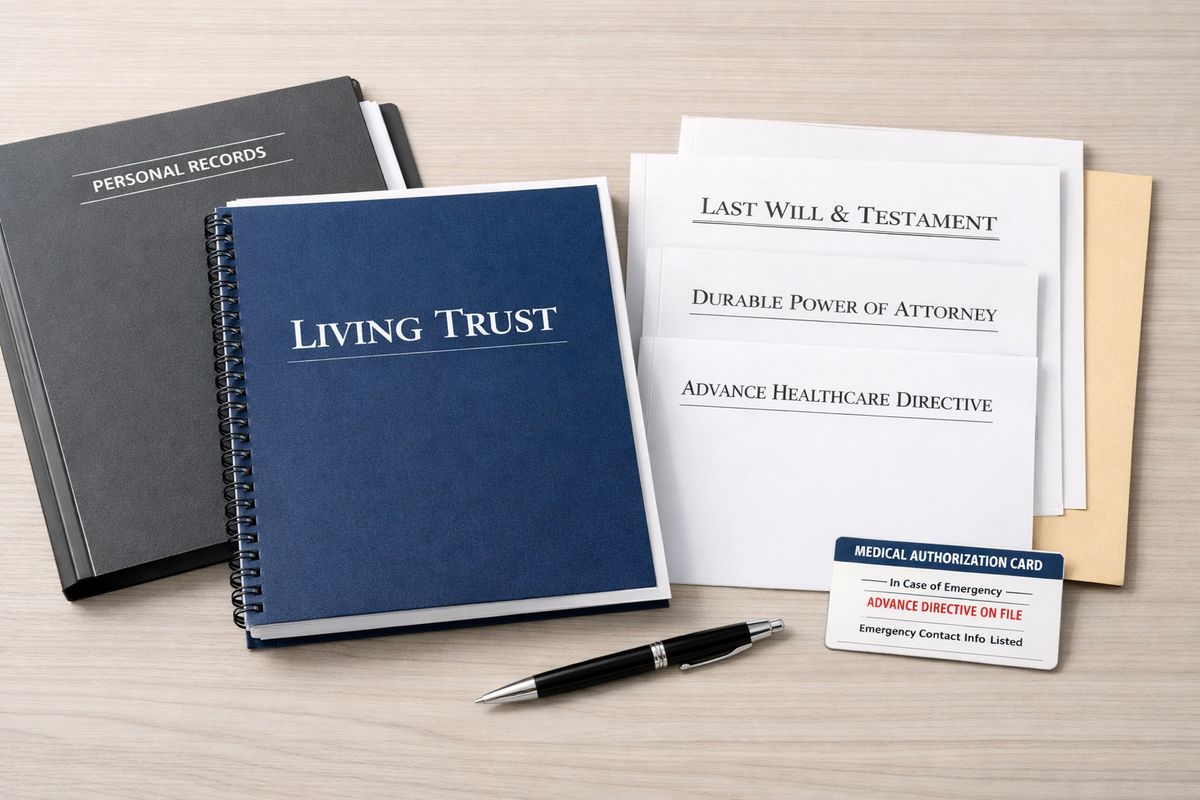
A will or trust is only part of the picture. Most complete California estate plans include supporting documents that cover areas those documents do not.
Durable financial power of attorney
A durable financial power of attorney lets you appoint someone to handle financial matters in your name. This can include tasks like dealing with taxes, signing contracts, handling benefits, or managing assets that were never transferred into your trust.
Even with a trust, this document matters because not every asset or legal issue sits inside the trust. Think of it as coverage for the edges of your financial life.
Advance health care directive
An advance health care directive names the person who can make medical decisions if you cannot. It can also include instructions about treatment preferences and end-of-life care.
Property planning gets a lot of attention, but medical planning is just as personal and often more urgent. This is the document that speaks when you cannot.
HIPAA authorization and related releases
Medical privacy rules can block access to information at the worst possible time. A HIPAA authorization helps the right person get medical information when it is needed.
That may sound like a small administrative detail. It is not. Without the right paperwork, even close family can hit a wall trying to talk with providers or understand what is happening.
Common mistakes that undercut an estate plan
Most estate plan failures do not happen because someone skipped planning entirely. They happen because the plan was started, then left half-finished or never updated.
Creating a trust but never funding it
This is the classic problem. The trust gets signed, but the house stays in your individual name, the accounts are never retitled, and the probate issue never really gets fixed.
Funding is the step where the plan becomes real. That means reviewing ownership, changing title where appropriate, and confirming what belongs in the trust. If you want a more detailed sense of that process, this guide to moving assets into the trust correctly is worth reading.
Forgetting to update beneficiary designations
Retirement accounts, life insurance, and many financial accounts pass by beneficiary form, not by your will or trust. If those forms are outdated, the wrong person can receive the asset even if every other estate planning document says otherwise.
This is one of the simplest fixes and one of the most expensive to ignore.
Not updating the plan after life changes
Marriage, divorce, births, deaths, a move, a new home purchase, business changes, and major shifts in net worth all deserve a fresh review. So does a move back into California after time away.
Estate plans age quietly. Years pass, signatures stay the same, and then one day the plan no longer matches your life.
Naming the wrong people for key roles
The best executor, trustee, guardian, or agent is not automatically the oldest child, the nearest relative, or the person least likely to say no. These roles involve judgment, follow-through, and sometimes a thick skin.
Choose the person who can actually do the job. That sounds obvious, but honestly, this is where sentiment often beats practicality, and that can create a mess later.
How to choose between a will-based plan and a trust-based plan
You do not need a flowchart taped to the fridge. A few focused questions usually make the right direction much clearer.
Questions to ask yourself
Do you own real estate in California? Do you have minor children? Do you want to avoid probate? Do you care about privacy? Do you need a plan for incapacity? Do you have a blended family, a business, a rental, or a second home?
If several of those get a yes, a trust-based plan often makes more sense. If most get a no and your estate is truly simple, a will-based plan may be enough for now. If you want a broader side-by-side comparison, this look at which approach fits different California plans can help sharpen the decision.
Cost now vs. cost later
A trust usually costs more upfront than a basic will. That part is easy to see. The harder part to see is the future cost of probate, delays, public filings, and court involvement if the plan is too bare for your situation.
This should not turn into a sales pitch. Sometimes the simpler plan is the right plan. But sometimes paying less now is just a way of passing more expense and stress to your family later. The smart comparison is not document price versus document price. It is setup cost versus total family burden over time.
What to bring when You’re ready to set up or update your plan
Once you decide to move forward, a little preparation saves a lot of back-and-forth. You do not need a perfect spreadsheet. You just need the right raw material.
Your asset list and how each asset is titled
Start with what you own, then go one step further and note how each asset is owned. That second part matters just as much as the list itself.
Is the account only in your name? Joint? Held in an LLC? Does it already have a beneficiary? Is the house titled individually or in a trust? Ownership details determine what your documents can control and what may still be exposed.
Your family, beneficiaries, and backup decision-makers
Write down who should inherit, who should manage the process, and who should step in if your first choice cannot serve. Include executors, trustees, guardians, agents under powers of attorney, and health care decision-makers.
Backups matter more than people think. Plans fail in ordinary ways. Someone moves, gets sick, becomes unavailable, or simply is not a fit anymore.
Your top goals
Before any meeting, try to name the top two or three things you most want your plan to do. Avoid probate. Protect children. Reduce family conflict. Plan for incapacity. Keep a house, business, or cabin easy to manage.
That one short exercise changes the whole conversation. Instead of buying documents, you start building a plan around the outcomes that matter most to you.
Frequently asked questions
Do you need both a will and a living trust in california?
In many cases, yes. A living trust can help avoid probate and manage assets during incapacity, while a will can nominate guardians for minor children and catch assets left outside the trust. For many California families, the two documents work better together than either one works alone.
Does a living trust completely replace a will?
No. Even with a trust, you usually still want a pour-over will. That will acts as a safety net for assets that were never transferred into the trust and handles guardian nominations for minor children.
If you have a will, do you still go through probate in california?
Often, yes. A will does not avoid probate by itself. If you die owning assets that require court administration, your will guides the process, but the estate may still need to go through probate.
What assets should usually go into a living trust?
Common examples include your home, some non-retirement investment accounts, and other major assets you want managed without probate. Retirement accounts usually are not retitled into a trust during life, though beneficiary designations still need review. The right mix depends on what you own and how each asset is titled.
Is a trust only for wealthy families?
No. In California, a trust is often about practicality more than wealth. Owning a home alone can make a trust worth considering because real estate values can push an estate into probate even when the rest of your finances are fairly ordinary.
How often should you update a will or trust?
Review your plan after major life changes and periodically even if nothing dramatic happens. Marriage, divorce, births, deaths, a home purchase, a move, business changes, or a big shift in assets are all good reasons to revisit everything.
One simple move that makes the rest easier
If your plan feels fuzzy, try one thing: make a list of your assets and note how each one is titled. That single page usually reveals whether your current setup is clean, incomplete, or headed straight toward probate.
Ready to take the next step? Get in touch with Elaine Andrews at The Andrews Law Firm to discuss your needs, request a personalized quote, and explore the best options for your situation. Whether you need an estate plan, a living trust, or guidance through probate, Elaine can help you move forward with confidence.
Contact us today to schedule your consultation.